Real Results
Before & After
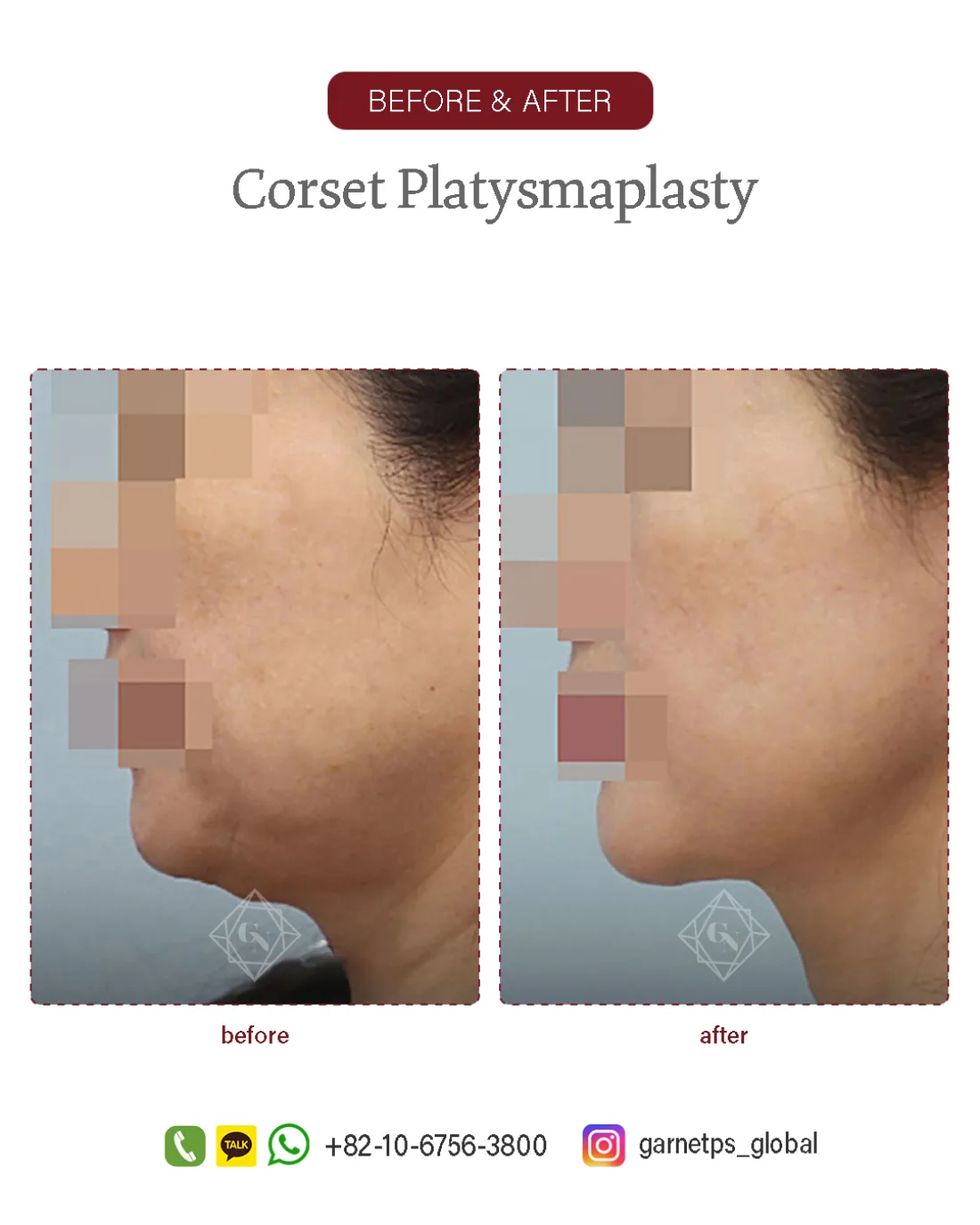
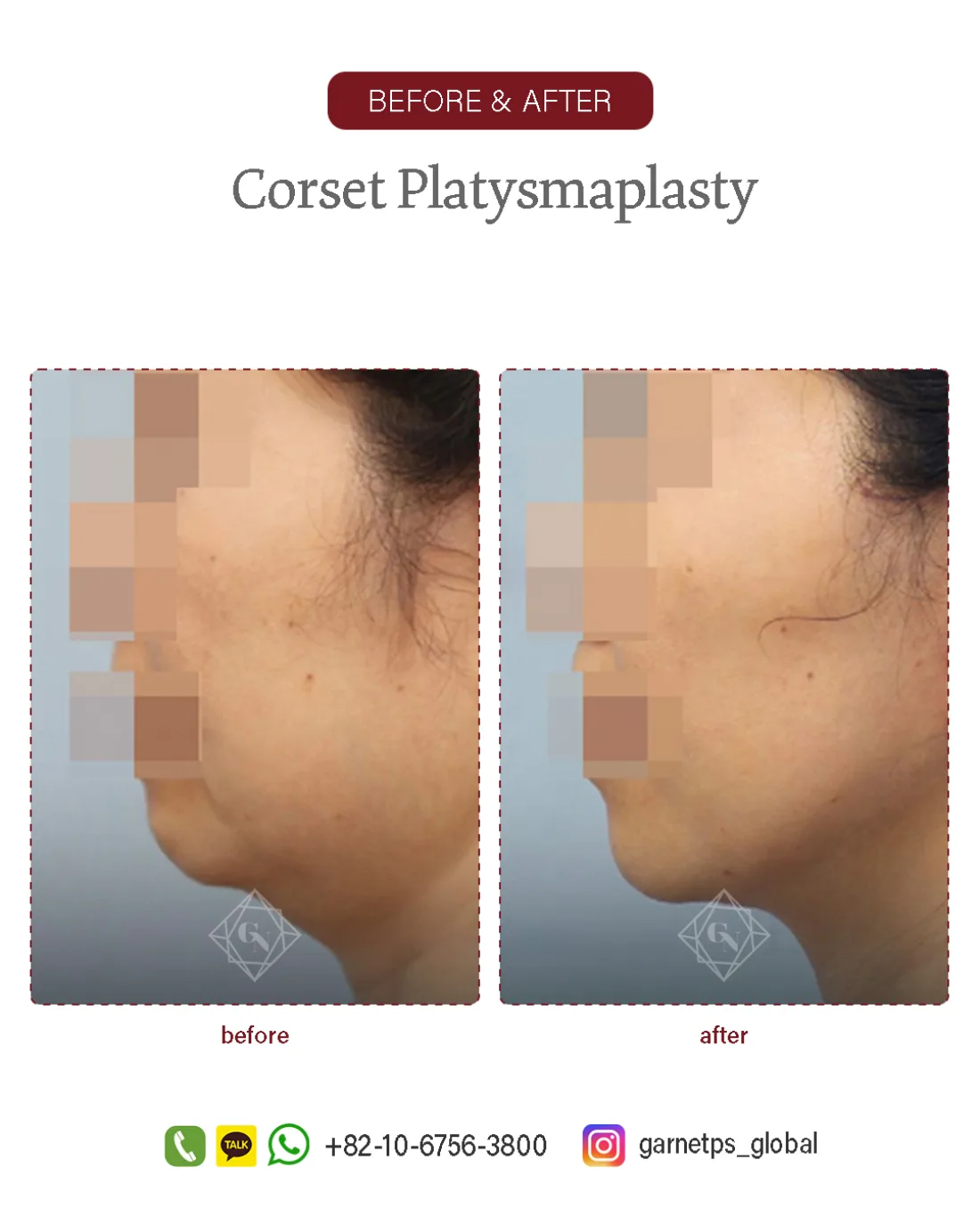
Corset platysmaplasty results of actual Garnet patients (published with consent). Results, recovery and suitability vary by individual — skin quality, muscle laxity and neck shape differ — and outcomes are not guaranteed.
A corset platysmaplasty tightens the neck muscle (the platysma) in the midline through a small hidden incision under the chin, redrawing a slack, banded neck into a smoother, sharper line. At Garnet it is planned and performed by one board-certified plastic surgeon, Dr. In-Soo Baek, from consultation through every follow-up.
Corset platysmaplasty results of actual Garnet patients (published with consent). Results, recovery and suitability vary by individual — skin quality, muscle laxity and neck shape differ — and outcomes are not guaranteed.

A corset platysmaplasty is a neck-rejuvenation operation that re-approximates the two medial edges of the platysma muscle along the midline of the neck with a continuous, multi-row suture — the way a corset is laced — through a single small incision hidden under the chin. By drawing the separated muscle back into one smooth sheet, it removes vertical neck bands and sharpens the cervicomental (under-chin) angle.
The platysma is a broad, thin muscle that sheets across the front of the neck. In youth its two halves meet in the midline; with age they separate and slacken, and the free inner edges become visible as the vertical cords often called neck bands. This muscle change — not only fat or skin — is a common reason a neck looks loose or “banded”, and it is what a corset platysmaplasty is designed to correct.
Through one hidden incision under the chin, the surgeon brings the two medial edges of the platysma together and stitches them in a continuous, multi-layered seam down the front of the neck. Closing this seam removes the free muscle edges that return as visible bands and re-creates a smooth, defined under-chin angle. Where fat also blurs the line, gentle liposuction is usually performed in the same sitting.
This is a single-surgeon operation. Dr. Baek plans the case from the consultation, performs it himself, and reviews healing at set intervals; the clinic caps the day at about two surgeries so each case has unhurried time. The stated aim is to address the neck concern you arrived with — not to chase the maximum possible change — and to be honest when loose skin means a neck lift would serve you better.
From a single hidden submental incision to the laced midline muscle seam and a contour garment — every step by Dr. Baek.
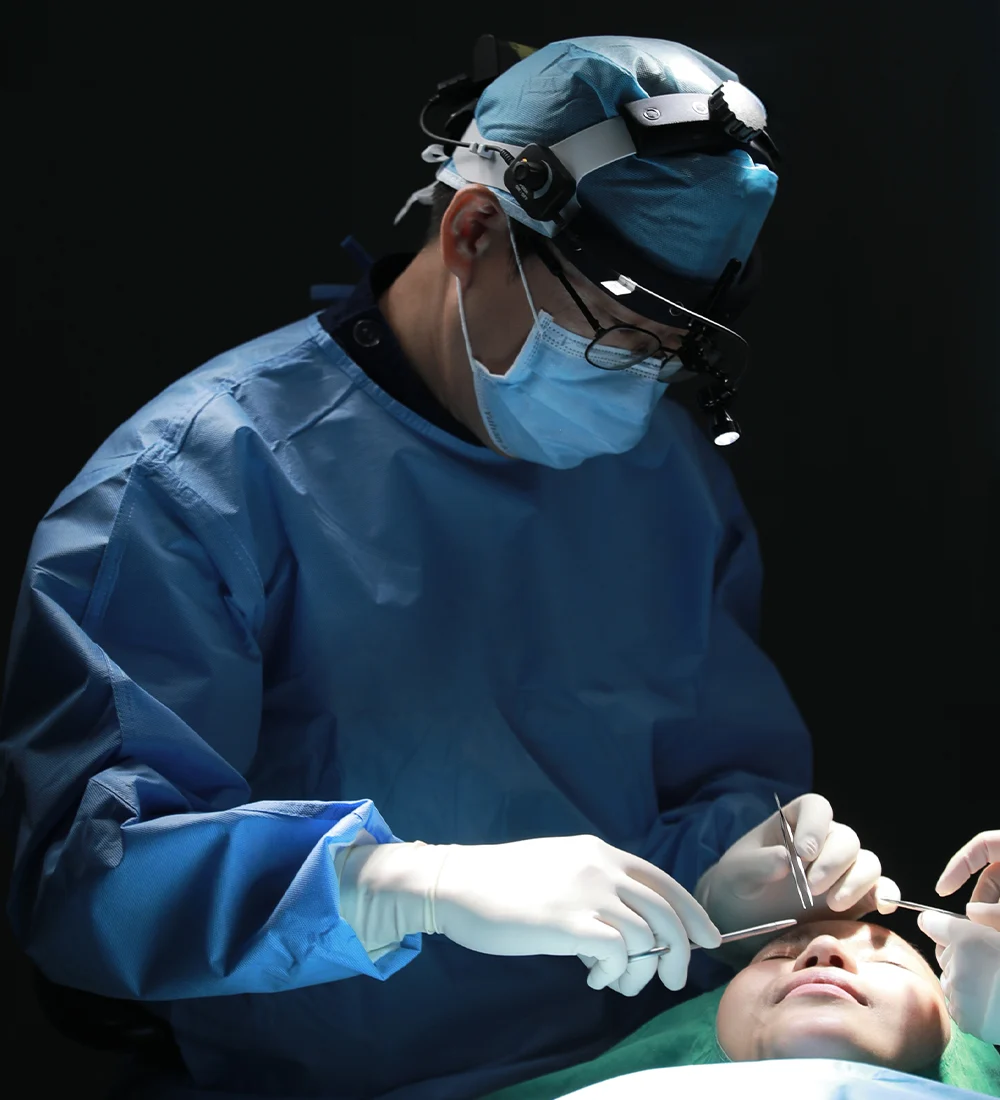
A single surgeon, start to finish. Dr. Baek plans the case, performs the operation himself and reviews every follow-up. The clinic caps the day at two surgeries, so each operation has unhurried time.
A corset platysmaplasty typically takes about 1.5–2.5 hours and is performed under local anaesthesia with sedation, or light general anaesthesia, decided with you for comfort over the procedure; the steps below outline how it is carried out at Garnet.
Dr. Baek assesses the neck in person — the platysmal bands, the under-chin angle, fat depth and skin elasticity — and agrees the plan with you, including whether liposuction or a lift should be combined. He is honest if muscle tightening alone will not meet your goal.
A single small incision is placed in the natural crease just under the chin (submental), so the scar sits in shadow and is not visible in normal head positions. The neck skin is gently lifted to reach the muscle.
Where excess submental fat is blurring the angle, it is conservatively reduced — often with fine liposuction in the same access — so the muscle work shows on a clean contour.
The two medial edges of the platysma are drawn together and stitched in a continuous, multi-row midline seam running down (and back up) the neck — the “corset” — leaving no free muscle edge to return as a band.
Where the consultation shows it, a Pelican™ neck refinement, lateral platysma work or a neck lift for loose skin is planned in the same sitting to complete the result.
The single incision is closed with fine sutures and a supportive chin/neck garment is applied to help the tissues settle. Because Garnet is single-surgeon, Dr. Baek reviews you himself before you settle in and at each follow-up.
The cervicomental angle — the angle between the under-chin and the neck — is what reads as a “sharp” or “soft” neck. Several layers shape it: skin, subcutaneous fat, the platysma muscle, and deeper structures. With age the paired platysma muscles diverge in the midline, their inner edges fall forward as vertical bands, and submental fat can collect, all of which blunt the angle. A corset platysmaplasty works on the muscle layer specifically, re-uniting the separated edges so the bands resolve and the angle re-forms (JAMA Facial Plast Surg 2016; DOI 10.1001/jamafacial.2015.2174).
The corset technique re-approximates the muscle with a continuous, infolded midline seam so no free muscle edge is left to reappear as a band, which is the principle behind its durability (Dermatol Surg 2002; DOI 10.1046/j.1524-4725.2002.01195.x). Because it tightens muscle rather than removing skin, it works best when fat and muscle — not loose skin — are the dominant problem; where skin is markedly lax, Dr. Baek assesses whether a lifting step should be combined, since muscle tightening alone will not redrape excess skin.
| Corset platysmaplasty | Facial liposuction | Neck lift | |
|---|---|---|---|
| Mainly addresses | Muscle bands & angle | Excess fat | Skin, muscle & fat |
| Corrects neck bands | Yes, directly | No | Yes (with platysma work) |
| Tightens loose skin | No | Relies on retraction | Yes, directly |
| Incision | One hidden submental | Tiny openings | Around-ear + submental |
| Best when | Bands, muscle is the issue | Fat is the issue | Lax skin too |
A cadaveric study quantified how midline corset platysmaplasty affects neck and face-lift redraping (JAMA Facial Plast Surg 2016; DOI 10.1001/jamafacial.2015.2174). The right choice is individual — where fat dominates, facial liposuction may be enough; where skin is lax, a neck lift is considered — and Dr. Baek advises at consultation.
A corset platysmaplasty is usually performed under local anaesthesia with sedation, or light general anaesthesia, decided with you and the anaesthesia team for comfort over a roughly 1.5–2.5 hour procedure. Your medical history is reviewed beforehand.
Because Garnet caps the day at about two surgeries, the operation is unhurried and the same surgeon who planned the case carries it out and reviews recovery — there is no separate operating doctor and no rotation of care.
Garnet is registered with Korea's foreign-patient programme; pre-operative checks, scheduling and after-care are coordinated for international visitors in English.
If muscle tightening alone will not meet your goal — for example where loose skin is the main issue — that is said at the consultation, and photos can be reviewed before you travel.
A corset platysmaplasty is performed through one small incision in the natural crease just under the chin. Because it sits in shadow beneath the jaw, the scar is not visible in normal head positions and is closed with fine sutures to settle as a faint line.
The scar is permanent but is designed to be inconspicuous in everyday settings once mature. Healing varies by individual and skin type; Dr. Baek reviews scar maturation and the neck contour at the 1-, 3- and 6-month visits and advises on scar care.
Wear the chin/neck garment as instructed, keep the head elevated, use cold compresses early, take medication as prescribed, sleep on your back, walk gently, and keep your follow-up visits.
Strenuous exercise, bending and heavy lifting early on, extreme neck movements, alcohol and smoking, very hot showers/saunas, and removing the garment before you are advised to.
Re-uniting the platysma in a continuous midline seam removes the free muscle edges that form bands, which is why the corset technique tends to give durable neck definition; the result settles over a few months as swelling resolves. Most patients keep the smoother, sharper under-chin line, particularly when skin quality was reasonable and weight stays broadly stable.
No neck procedure stops ageing. Over the long term the muscle and skin continue to age, skin laxity can develop, and weight change can alter the area, so the definition can soften — more so where skin elasticity was already limited. Garnet's approach is to plan a clean, even tightening from the start; if skin laxity later becomes the issue, it is addressed separately by a lifting option.
Where submental and jawline fat also blur the angle, gentle facial liposuction is usually done through the same access in the same sitting, since fat removal and muscle tightening address different causes.
A Pelican™ neck refinement can further define the under-chin and neckline where the consultation shows it adds to the corset result.
Where loose skin is part of the picture, a neck lift is combined so skin as well as muscle and fat is addressed for a more complete result.
Where the lower face or chin would benefit from restored volume, fat grafting can be planned alongside to balance the overall profile.
Every operation carries risk. For neck and platysma surgery the more common early issues are swelling, bruising and temporary tightness or numbness under the chin; less common are small fluid or blood collections, asymmetry, and a recurrence of mild banding over time. Overall, corset platysmaplasty is described as a safe and effective neck-rejuvenation method in the literature (Dermatol Surg 2002; DOI 10.1046/j.1524-4725.2002.01195.x), but no result is guaranteed.
Other possible risks include temporary or, rarely, lasting changes in skin sensation, scar-related issues at the submental incision, residual skin laxity where elasticity was limited, and — uncommonly — a contour irregularity needing revision. Smoking raises wound-healing risk. These are explained individually at consultation.
What reduces risk in practice: careful patient selection (muscle, not loose skin, as the cause), meticulous suture technique with no free muscle edge left, a supportive garment, and follow-up by the operating surgeon. Garnet's single-surgeon, low-volume model is built around exactly this kind of unhurried planning and personal after-care.
Most international patients plan roughly 8–12 days in Korea for a corset platysmaplasty, so the submental sutures can be removed by the surgeon and the early swelling has begun to settle before travel. The coordinator confirms the timing for your specific plan.
Before you travel, send clear photos (front, three-quarter, side and a chin-down view) and a note on your concern and dates through WhatsApp, LINE or the form below. You'll get an honest pre-assessment — including whether muscle tightening, fat removal or a lift fits your neck — rather than a hard sell.
Garnet is registered with Korea's foreign-patient programme and coordinates consultations, scheduling and after-care in English. After you return home, Dr. Baek can continue to review your recovery and the settling neckline by messenger.
| Corset platysmaplasty | Facial liposuction | Neck lift | |
|---|---|---|---|
| Mainly addresses | Muscle bands & angle | Excess fat | Skin, muscle & fat |
| Corrects neck bands | Yes, directly | No | Yes (with platysma work) |
| Tightens loose skin | No | Relies on retraction | Yes, directly |
| Incision | One hidden submental | Tiny openings | Around-ear + submental |
| Best when | Bands, muscle is the issue | Fat is the issue | Lax skin too |
Citations are provided for general education. This page is informational and does not replace an in-person consultation; suitability, technique and recovery are individual.
Send photos and your question before you travel. An English-speaking coordinator reviews every enquiry and replies with honest guidance on whether surgery is appropriate, the likely plan and timing.
Prefer to chat now? Reach the coordinator directly: