
Garnet Plastic Surgery · Apgujeong, Seoul — one board-certified surgeon, eye · nose · lifting
Procedures
Eye Surgery
Lower blepharoplasty Upper blepharoplasty Non-incision double eyelid Incision double eyelid Ptosis correction Epicanthoplasty Lateral canthoplasty Under-eye fat repositioning Sub-brow / brow lift Round eye correction
Rhinoplasty
Rhinoplasty Implant-free rhinoplasty Revision rhinoplasty Rib-cartilage rhinoplasty Septal/ear-cartilage rhinoplasty
Facial Lifting
Mini facelift Deep mini facelift™ Full facelift Neck lift
Forehead & Brow
Forehead lift Forehead reduction
Fat Grafting & Contouring
Fat grafting Stem cell fat grafting Pelican™ double-chin & neck contouring Fixpoint Thread Lift™ Neck/cheek/jawline liposuction Corset platysmaplasty
Surgeon Trademarks Before & After Visiting FAQ Book Consultation
Garnet/Rhinoplasty/Rib-cartilage rhinoplasty
Board-certified Plastic Surgeon · Apgujeong, Seoul

Rib-cartilage rhinoplasty — a framework built from your own rib, by the surgeon who follows you through it.

Rib-cartilage rhinoplasty rebuilds the nose with strong costal (rib) cartilage, for cases that need more structural support than the septum or ear can supply. At Garnet it is planned and performed by one board-certified plastic surgeon, Dr. In-Soo Baek, from consultation through every follow-up.

Rib
framework strength
~10 days
rib-site sutures out
1
surgeon, every step
Anaesthesia
Discussed at consultation
Surgery time
Longer (rib harvest)
Sutures out
Nose ~7 / rib ~10 days
Social downtime
~2–3 weeks
Follow-up
1 / 3 / 6 months
10,000+ rhinoplasty cases since 2011· Board-certified plastic surgeon — accredited member, Korean Society of Plastic & Reconstructive Surgeons· Foreign-patient programme registered· Single-surgeon practice

The bottom line

What it is
A rhinoplasty that builds the nasal framework from costal (rib) cartilage — autologous from your own chest or processed donor rib — for noses that need substantial, lasting structural support.
Best for
Low or under-projected bridges, significant rebuilding, and revision noses where septal and ear cartilage are not enough to provide the support required.
Who performs it
Dr. In-Soo Baek only — a board-certified plastic surgeon and Garnet's sole operating doctor. The same surgeon consults, operates and follows up.
Downtime
Nose sutures come out around 7 days and the rib donor-site sutures around 10 days; most social downtime is over by roughly 2–3 weeks; the tip settles over several months.
Material
Autologous rib (your own) or processed donor rib, chosen with you — both avoid a permanent implant by rebuilding with cartilage.
How to start
Send photos through WhatsApp or the form below for an honest, no-obligation pre-assessment before you travel.
Candidacy What it is How it's performed Why rib cartilage Rib vs septal/ear vs implant Anaesthesia & safety Incisions & scars Before & after Recovery Longevity Combining Risks International patients FAQ

Is it right for you?

Often a good fit

  • A low or under-projected nose that needs substantial structural rebuilding
  • A revision nose where septal and ear cartilage are insufficient for the support required
  • A wish to avoid a permanent implant by rebuilding with cartilage
  • General good health and willingness to plan ~2–3 weeks of social downtime
  • Acceptance of a chest donor site, or a preference for processed donor rib instead

Worth discussing other options

  • A nose needing only modest tip support, where septal/ear cartilage may be more proportionate
  • Looking for a same-week, no-downtime change
  • Uncontrolled medical conditions, or chest-wall issues that affect harvest — assessed individually
  • Unwilling to accept the small possibility of cartilage warping over time
  • Active smoking, which raises wound-healing risk — discussed and planned around
Dr. In-Soo Baek

Dr. In-Soo Baek

Director & sole operating surgeon
Korean medical licence no. 77407
  • Board-certified plastic surgeon
  • Korea University College of Medicine & graduate school (plastic surgery)
  • Member, Korean Society of Plastic and Reconstructive Surgeons (facial-contour, eye & rhinoplasty groups)
  • Every case planned, performed and followed up by the same surgeon
About the surgeon →

Building the nose from costal cartilage

Rib-cartilage rhinoplasty is a nose operation that reconstructs the dorsum, septal support and tip using costal (rib) cartilage — taken either from the patient's own chest (autologous) or supplied as processed donor rib — rather than from the nasal septum, ear, or a synthetic implant. Because rib provides a large volume of strong, structural cartilage, it is the usual choice when a nose needs substantial rebuilding that softer grafts cannot deliver.

Some noses cannot be built from septal or ear cartilage alone. A very low bridge, a markedly under-projected tip, a structurally weak framework, or a revision where the septum has already been used all call for more cartilage than those sources hold. Rib cartilage answers that need: a single rib segment yields enough material to rebuild the dorsum, lengthen and support the septum, and reinforce the tip in one operation.

At Garnet, rib is used as a structural autologous solution rather than a default. Where less support is missing, septal and ear cartilage are preferred for their simpler recovery; rib is chosen when the case genuinely needs its strength and volume, including many revision noses. Both autologous rib and processed donor rib are discussed, and the choice is made with you.

This is a single-surgeon operation. Dr. Baek plans the case from the consultation, harvests and shapes the rib and performs the rebuild himself, and reviews healing at set intervals; the clinic caps the day at two surgeries so a longer rib operation has unhurried time. The stated aim is to give the nose durable support for the concern you arrived with, rather than to chase the maximum possible change.

One surgeon, one plan

From rib harvest and carving to the framework rebuild and donor-site closure — every step by Dr. Baek.

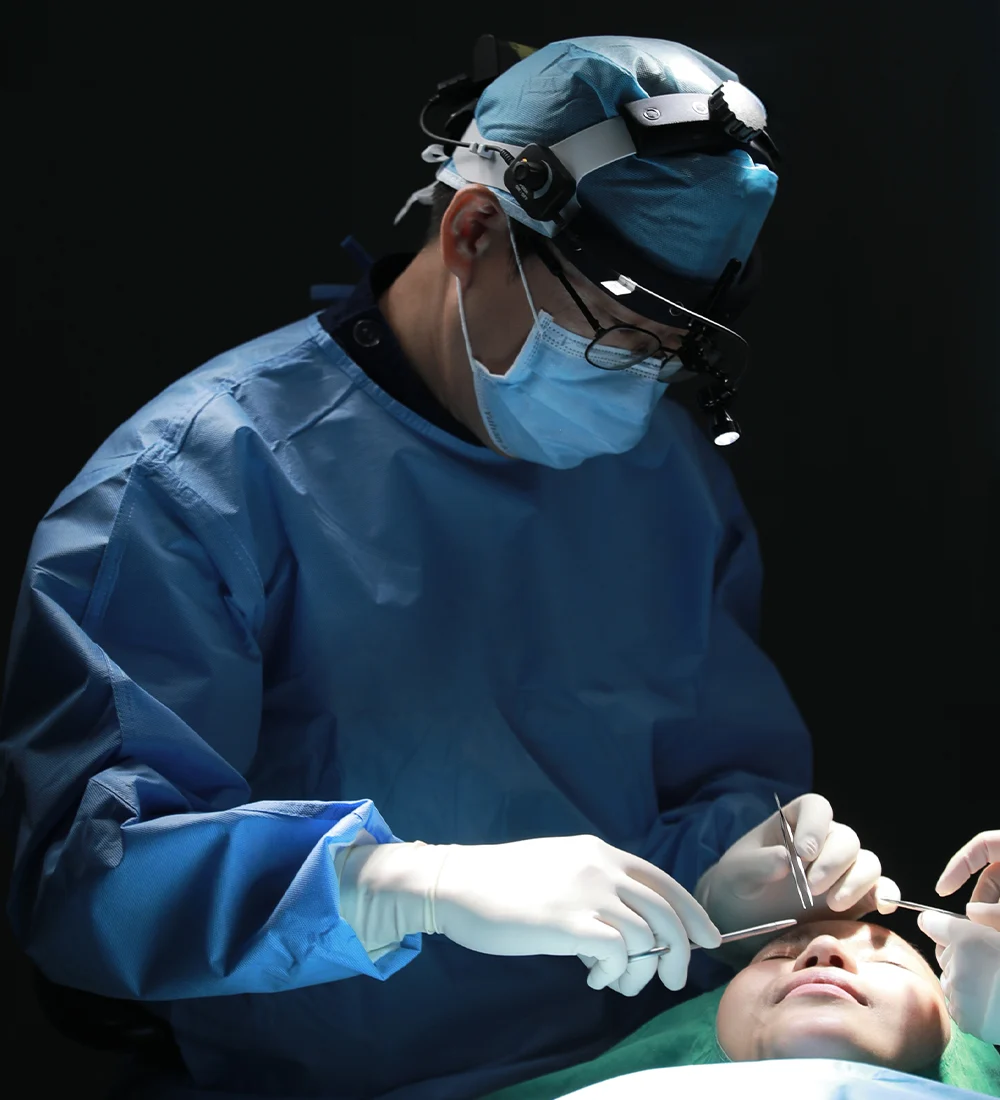
Dr. In-Soo Baek performing surgery at Garnet Plastic Surgery, Apgujeong

A single surgeon, start to finish. Dr. Baek plans the case, performs the operation himself and reviews every follow-up. The clinic caps the day at two surgeries, so each operation has unhurried time.

Rib-cartilage rhinoplasty is longer than a septal or ear-cartilage case because the rib is harvested, carved and allowed to settle before final placement; the exact time depends on how much rebuilding the nose needs. Anaesthesia is decided with you and the anaesthesia team at consultation after your history is reviewed, rather than fixed in advance. The steps below outline how it is carried out at Garnet.

01

Consultation & planning

Dr. Baek examines the nose, bridge height, tip support and skin in person, discusses autologous versus donor rib, and agrees the plan with you. Imaging is used where it helps map the rebuild.

02

Rib harvest

A short, hidden incision in the chest crease allows a rib-cartilage segment to be taken with care for the surrounding tissue. With processed donor rib this step is omitted, avoiding a chest incision.

03

Carving & balancing

The cartilage is carved into the grafts the nose needs — dorsal graft, septal extension or strut, tip support — using balanced, concentric cuts and a settling period to limit the warping rib is known for.

04

Framework rebuild

Through an open or closed approach as the case requires, the carved grafts rebuild the dorsum, lengthen and support the septum, and reinforce the tip, so the result rests on a rebuilt structure.

05

Refinement & closure

The tip is shaped and the framework checked for symmetry; incisions on the nose and, where used, the chest are closed; a splint and dressing are applied.

06

Dressing & review

Garnet's protocol includes dressing changes early in recovery. Because the clinic is single-surgeon, Dr. Baek reviews you himself before you settle in and at each follow-up.

Why rib, and what warping means

Costal cartilage is the body's most abundant source of strong, autologous graft material, which is why it is the workhorse for major nasal reconstruction. A segment of rib provides enough cartilage to carve a dorsal graft, a septal-extension or strut for the tip, and reinforcing grafts, all from one donor site — something neither the septum nor the ear can match in volume or rigidity (Aesthet Surg J 2015; DOI 10.1093/asj/sju117).

The trade-off is a recognised tendency for rib cartilage to warp — to bend slightly as it equilibrates after carving. Surgical strategies to limit this include balanced carving, concentric (symmetric) cuts, a settling period before final placement, and sometimes internal stabilisation; a systematic review of warping-prevention techniques summarises these (J Craniofac Surg 2020; DOI 10.1097/SCS.0000000000006429). Understanding warping is why rib work is planned and carved carefully rather than rushed.

Rib vs septal/ear cartilage vs implant

Septal / ear cartilageRib (costal) cartilageSilicone implant
Material sourceSeptum & ear (own)Rib — own or donorSynthetic
Volume & strengthLimitedLarge & structuralFixed, non-biological
Donor siteMinimal (behind ear)Chest (or none if donor rib)None
Best forTip & modest supportMajor rebuilding / revisionDorsal augmentation only
Main cautionMay be insufficientPossible warpingLong-term implant risks

A systematic review of autologous costal cartilage reports recipient-site warping at about 5% and infection at about 2.5% (Aesthet Surg J 2015, DOI 10.1093/asj/sju117), with carving strategies used to limit warping. Which material suits your nose is individual — Dr. Baek advises at consultation.

How your safety is handled

Anaesthesia

The anaesthesia for a rib case is chosen with you and the anaesthesia team at consultation, suited to the longer operation and your medical history, rather than set in advance. Your history is reviewed beforehand, including chest-wall considerations for the harvest.

Single-surgeon monitoring

Because Garnet caps the day at two surgeries, a longer rib operation is unhurried and the same surgeon who planned the case carries it out and reviews recovery — there is no separate operating doctor and no rotation of care.

Foreign-patient programme

Garnet is registered with Korea's foreign-patient programme; pre-operative checks, scheduling and after-care are coordinated for international visitors in English.

Honest assessment

If rib cartilage is more than your nose needs, or a lighter option suits you better, that is said at the consultation. Photos can be reviewed before you travel.

Where the incisions sit

Rib-cartilage rhinoplasty has two possible incision sites. On the nose, an open approach leaves a small columellar scar that falls in a natural shadow, with hidden incisions inside the nostrils; a closed approach keeps the nasal incisions inside. At the chest, autologous rib is taken through a short incision placed in a natural skin crease, where it is designed to be discreet once mature. Choosing processed donor rib avoids the chest incision entirely.

Scars are permanent but are placed where they hide, and Dr. Baek reviews them at the 1-, 3- and 6-month visits with scar-care advice. Healing varies by individual and by skin type; the chest scar in particular is discussed honestly at consultation, including for patients prone to thicker scarring.

Before & After

Rib-cartilage rhinoplasty results are individual and identifiable, so before/after sets are reviewed privately at consultation with consent rather than published here. Results, recovery and suitability vary by individual and are not guaranteed.

Week by week

Days 1–3
A splint and dressing protect the rebuild and the chest site is dressed where rib was harvested. Swelling and bruising build over the first few days; rest with the head elevated. Chest discomfort with breathing or movement is usual early and is managed with prescribed medication.
Days 4–7
Facial swelling begins to ease and bruising fades. Gentle walking is encouraged. Nose sutures are typically removed around day 7; the chest is reviewed.
Days 7–10
The splint comes off in this window and the rib donor-site sutures are typically removed around day 10. Chest soreness keeps easing. The nose looks fuller than its final form at this stage.
Weeks 2–4
Most social downtime is over for everyday settings, with residual swelling that keeps easing. Light routine resumes as advised; strenuous activity, heavy lifting and contact with the nose wait longer while the chest settles.
Months 1–6
Tip swelling settles slowly and the scars mature over the following months. Dr. Baek reviews healing at one, three and six months — in person, or by messenger after you return home.

Do

Keep the head elevated, take medication as prescribed, support the chest when coughing early on, sleep on your back, protect the splint, and keep your follow-up visits.

Avoid

Bumping or pressing the nose, glasses on the bridge early on, heavy lifting and strenuous exercise while the chest heals, alcohol and smoking, very hot showers/saunas, and direct sun on healing scars until cleared.

How long does it last?

Once a rib-cartilage nose has fully healed, the framework is intended to give durable, lasting support because it rebuilds structure with strong autologous cartilage rather than relying on the skin or a synthetic implant. The main longer-term consideration is subtle warping — a slow bend in the carved cartilage — which careful, balanced carving is designed to limit (J Craniofac Surg 2020; DOI 10.1097/SCS.0000000000006429).

Individual longevity depends on tissue quality, the carving and the nose's protection during healing. Garnet's approach is to carve and stabilise the rib carefully and to rebuild conservatively, since a well-balanced framework tends to age more predictably. Minor refinements are occasionally discussed if healing leaves a small irregularity.

Often planned together

Septal & ear cartilage

For tip refinement that does not need rib's strength, septal and ear cartilage can be combined with the rib framework to fine-tune definition.

Revision rhinoplasty

Rib is a common choice for revision noses where the septum has already been used and major rebuilding is required.

Functional work

Septal or nasal-valve correction is addressed in the same sitting where breathing has been affected, so shape and airway are treated together.

Soft-tissue camouflage

Temporalis fascia is used to smooth dorsal contour seen through thin skin over a rib framework where indicated.

An honest word on risk

Every operation carries risk, and rib-cartilage rhinoplasty adds two areas — the nose and the chest donor site. With costal cartilage the recognised graft issues include warping, partial resorption, displacement and, less commonly, infection; a systematic review reported warping in about 5% and infection in about 2.5% of cases (Aesthet Surg J 2015; DOI 10.1093/asj/sju117). Carving strategy is planned to reduce warping.

Donor-site risks at the chest include pain, scarring and, uncommonly, pneumothorax (air around the lung); processed donor rib avoids the chest incision but is not the patient's own tissue. Nasal risks include asymmetry, contour irregularity, prolonged tip swelling, breathing change and scar-related issues. Smoking raises wound-healing risk. These are explained individually at consultation.

What reduces risk in practice: careful patient selection, balanced and concentric carving with a settling period, meticulous harvest technique, and follow-up by the operating surgeon. Garnet's single-surgeon, low-volume model is built around exactly this kind of unhurried planning and personal after-care.

Planning from abroad

Most international patients plan roughly 10–14 days in Korea for a rib-cartilage rhinoplasty, so the splint and both the nose sutures (around day 7) and the chest sutures (around day 10) can be removed by the surgeon before travel. The coordinator confirms the schedule for your specific plan.

Before you travel, send clear photos (front, three-quarter, side and base) and a note on your concern and dates through WhatsApp, LINE or the form below. You'll get an honest pre-assessment — including whether rib is the right material — rather than a hard sell.

Garnet is registered with Korea's foreign-patient programme and coordinates consultations, scheduling and after-care in English. After you return home, Dr. Baek can continue to review your recovery by messenger.

Guides for international patients

Questions about this procedure

When is rib cartilage needed instead of septal or ear cartilage?
Rib is chosen when the nose needs more structural support than the septum or ear can supply — a low bridge, major rebuilding, or many revision cases. For modest tip work, septal and ear cartilage are usually preferred for their simpler recovery.
Is it my own rib or donor rib?
Both are options. Autologous rib uses your own chest cartilage and needs a small chest incision; processed donor rib avoids that incision but is not your own tissue. The choice is discussed with you and decided at consultation.
Septal / ear cartilageRib (costal) cartilageSilicone implant
Material sourceSeptum & ear (own)Rib — own or donorSynthetic
Volume & strengthLimitedLarge & structuralFixed, non-biological
Donor siteMinimal (behind ear)Chest (or none if donor rib)None
Best forTip & modest supportMajor rebuilding / revisionDorsal augmentation only
Main cautionMay be insufficientPossible warpingLong-term implant risks
Does Dr. Baek perform the surgery himself?
Yes. Garnet is a single-surgeon practice, so Dr. Baek handles the consultation, the rib harvest and rebuild, and the follow-up personally — there is no separate operating doctor and no rotation of care.
Does rib cartilage warp?
Rib has a known tendency to bend slightly as it settles after carving. Balanced, concentric carving and a settling period before placement are used to limit this; a published review reports warping in roughly 5% of costal cartilage cases. It is discussed honestly at consultation.
What anaesthesia is used and how much pain is there?
Anaesthesia is decided with you and the anaesthesia team after your history is reviewed, suited to the longer operation. Most patients describe chest soreness with movement and nasal pressure rather than sharp pain in the first days, managed with prescribed medication.
Where are the scars?
On the nose, an open approach leaves a small columellar scar in a natural shadow with hidden internal incisions. Autologous rib adds a short scar in a chest crease; choosing donor rib avoids the chest incision entirely.
How long should I stay in Korea?
Most international patients plan about 10–14 days, so the splint, the nose sutures around day 7 and the chest sutures around day 10 can be removed by the surgeon before travel. The coordinator confirms timing for your plan.
When will I look presentable?
Most social downtime is over by about 2–3 weeks for everyday settings, once the splint is off and the major swelling and bruising have eased. The refined tip develops slowly over the following months.
How long does a rib rhinoplasty last?
Once fully healed, a rib framework is intended to give durable, lasting support because it rebuilds structure with strong autologous cartilage. The main longer-term consideration is subtle warping, which careful carving is planned to limit.
Will the chest be very painful?
Chest discomfort with breathing and movement is usual in the first days and eases over the following weeks, managed with prescribed medication. Supporting the chest when coughing and avoiding heavy lifting early on help recovery.
What are the main risks?
Nasal risks include asymmetry, prolonged tip swelling and possible warping; chest risks include pain, scarring and, uncommonly, pneumothorax. Donor rib avoids the chest incision but is not your own tissue. All are discussed individually at consultation.
Can I see rib rhinoplasty before-and-after photos?
Rib rhinoplasty results are individual and identifiable, so full sets are reviewed privately at consultation with consent rather than published. You can discuss what is realistic for your nose with Dr. Baek directly.
Is rib better than a silicone implant?
They are different tools, not better or worse. Rib rebuilds with your own cartilage and avoids a permanent implant; a standard rhinoplasty may use a dorsal implant with autologous tip cartilage. The right choice depends on the nose and is decided at consultation.
How do I start without flying to Korea first?
Send photos and your dates through WhatsApp, LINE or the form below. You'll get an honest pre-assessment — including whether rib is the right material — before you plan a trip to Garnet in Apgujeong.
Can rib be combined with other nose work?
Yes. A rib framework is often refined with ear or septal cartilage at the tip, and functional septal or valve work is done in the same sitting where breathing is affected, so shape and airway are addressed together.

Sources

  1. Varadharajan K, Sethukumar P, Anwar M, Patel K. Complications Associated With the Use of Autologous Costal Cartilage in Rhinoplasty: A Systematic Review. Aesthet Surg J. 2015. DOI 10.1093/asj/sju117. link
  2. Wee JH, et al. Prevention of Autologous Costal Cartilage Graft Warping in Secondary Rhinoplasty. J Craniofac Surg. 2020. DOI 10.1097/SCS.0000000000006429. link
  3. Kim JH, et al. Enhanced revision rhinoplasty with processed costal cartilage guided by preoperative computed tomography and 3D scanning. Maxillofac Plast Reconstr Surg. 2024. DOI 10.1186/s40902-024-00422-z. link
  4. Wee JH, et al. Donor site morbidities resulting from conchal cartilage harvesting in rhinoplasty. Arch Facial Plast Surg. 2007. DOI 10.1001/archfaci.9.4.298. link

Citations are provided for general education. This page is informational and does not replace an in-person consultation; suitability, technique and recovery are individual.

Ask Dr. Baek’s team

Send photos and your question before you travel. An English-speaking coordinator reviews every enquiry and replies with honest guidance on whether surgery is appropriate, the likely plan and timing.

  • Reviewed by the clinic coordinator, not a bot
  • Photo-based pre-assessment before you fly
  • Foreign-patient scheduling & after-care
  • One surgeon for consultation, surgery and follow-up

Prefer to chat now? Reach the coordinator directly:

Request a consultation

  • WhatsApp
  • LINE
  • WeChat
  • Telegram
  • Email
  • Eye surgery
  • Rhinoplasty
  • Facial lifting
  • Forehead & brow
  • Fat grafting & contouring
  • Revision

Submits in real time to Garnet’s Supabase intake (branch: garnet). Your details are handled per our privacy policy.

Book consultation