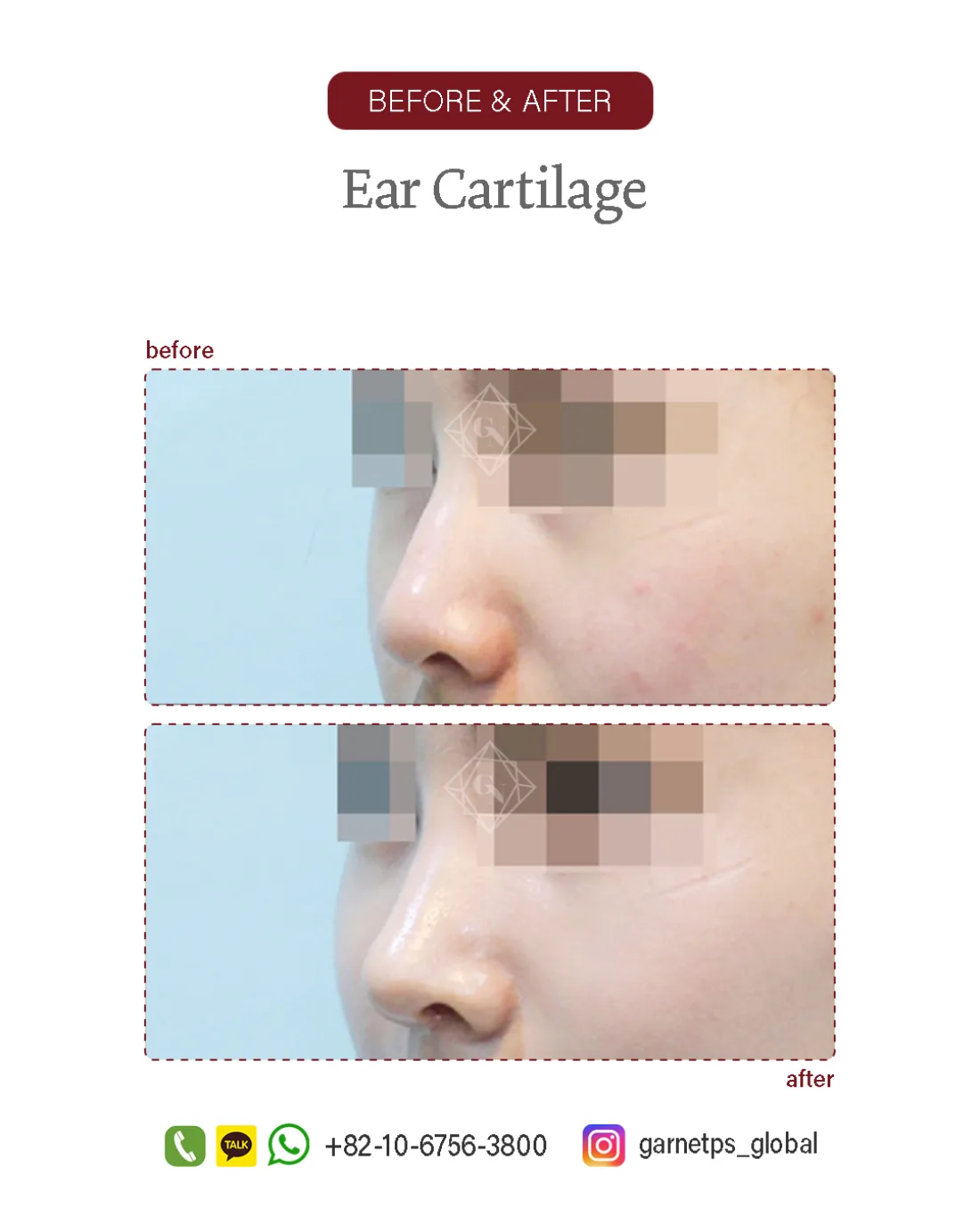
Septal and ear-cartilage rhinoplasty refines the nasal tip and supports the framework using the patient's own septal and ear (conchal) cartilage, without a permanent implant. At Garnet it is planned and performed by one board-certified plastic surgeon, Dr. In-Soo Baek, from consultation through every follow-up.
Ear-cartilage rhinoplasty result of an actual Garnet patient, Apgujeong (published with consent; same lighting and angle before and after). Results, recovery and suitability vary by individual and are not guaranteed; further sets are reviewed privately at consultation.
Septal and ear-cartilage rhinoplasty is a nose operation that projects and defines the nasal tip using the patient's own septal cartilage — for straight, structural grafts — and ear (conchal) cartilage, whose natural curve suits the soft contour of the tip. Because it rebuilds with the patient's own tissue rather than a synthetic implant, it is an autologous, structural approach used when a nose needs cartilage support without the larger volume of rib.
Tip refinement is often less about adding height to the bridge than about giving the tip structure: projection, rotation and definition that hold their shape. Septal cartilage, taken from the central wall of the nose, provides straight, firm grafts ideal for a septal-extension graft or tip strut; ear (conchal) cartilage, with its gentle natural curve, suits the rounded contour of the tip and the alar rim.
At Garnet this combination is used when a nose needs autologous support but not the volume of rib cartilage. It pairs naturally with an implant-free philosophy and is a common choice in revision work where modest support is missing. The two cartilages complement each other — the straight septum for the backbone, the curved ear for the surface.
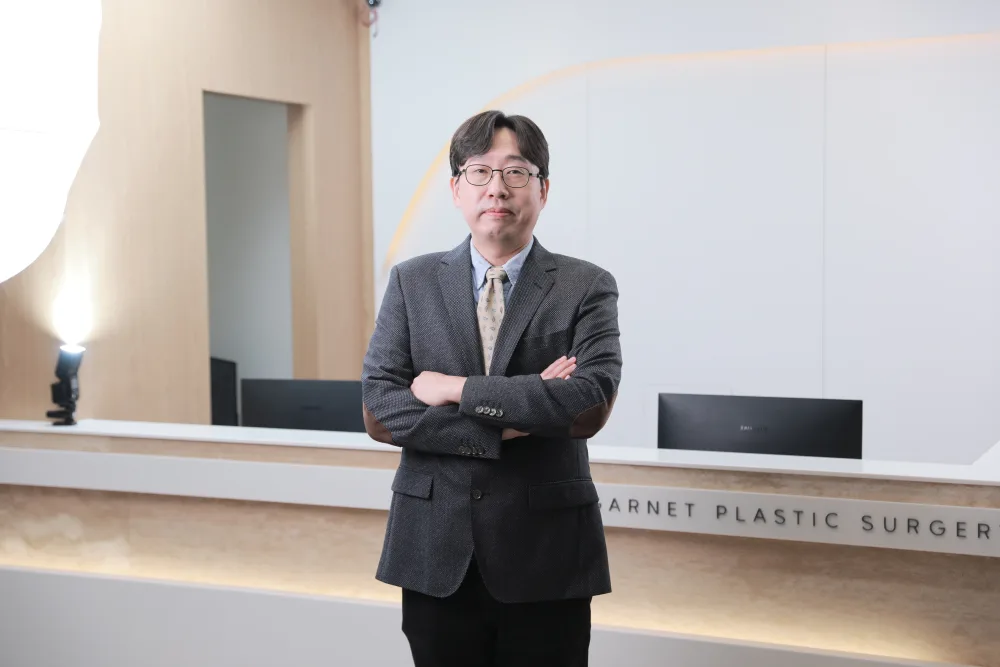
This is a single-surgeon operation. Dr. Baek plans the case from the consultation, harvests and shapes the cartilage and performs the rebuild himself, and reviews healing at set intervals; the clinic caps the day at two surgeries so each case has unhurried time. The stated aim is to refine the tip for the concern you arrived with, rather than to chase the maximum possible change.
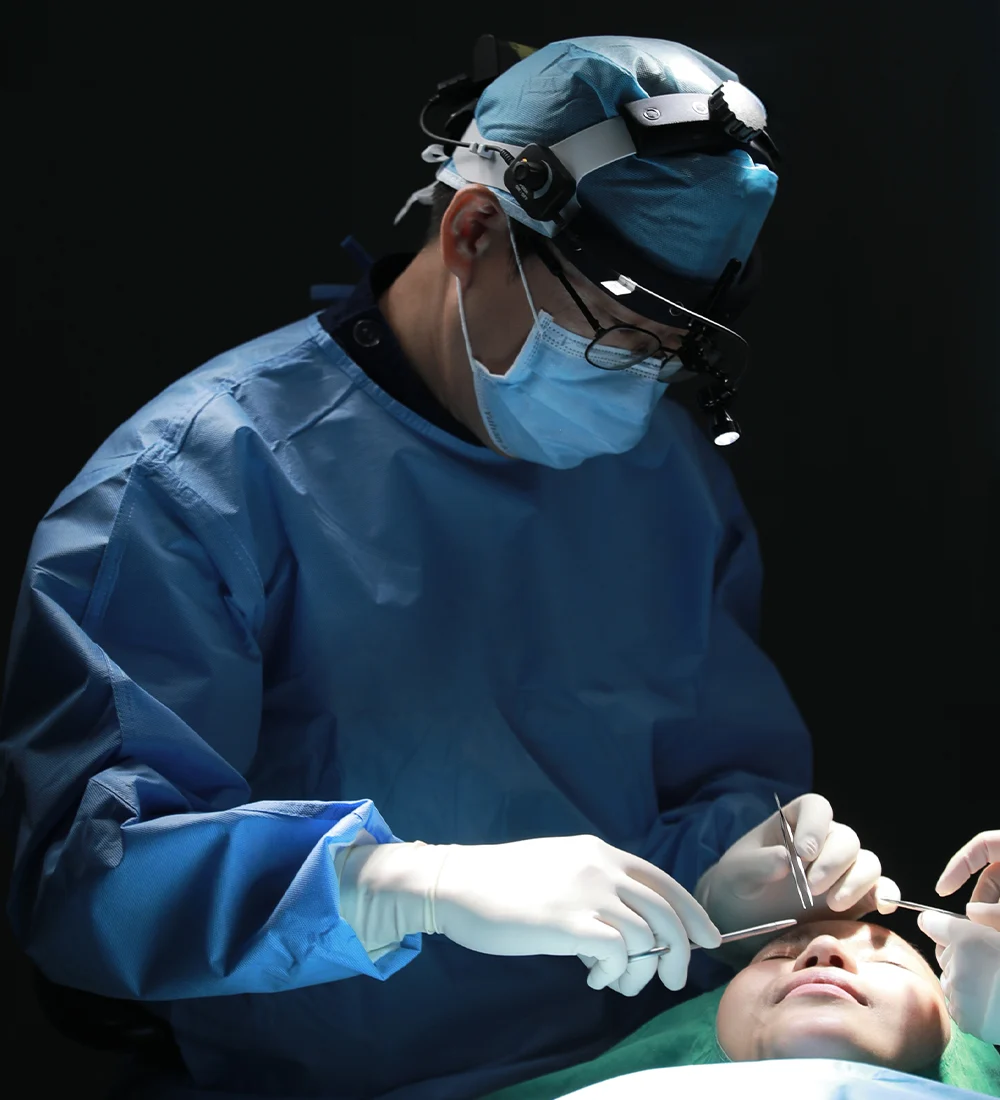
From cartilage harvest to tip grafting and donor-site closure — every step by Dr. Baek.
A single surgeon, start to finish. Dr. Baek plans the case, performs the operation himself and reviews every follow-up. The clinic caps the day at two surgeries, so each operation has unhurried time.
The operation can be closed or open depending on the case, and the time depends on how much tip work and grafting the nose needs; it is generally shorter and simpler to recover from than a rib case. Anaesthesia is decided with you and the anaesthesia team at consultation after your history is reviewed, rather than fixed in advance. The steps below outline how it is carried out at Garnet.
Dr. Baek examines the tip, its support and the skin in person, checks how much septal cartilage is available, and agrees the plan with you. Imaging is used where it helps map the grafting.
Septal cartilage is taken from within the nose, preserving an L-strut for support, to supply straight structural grafts. This adds no external incision because the septum sits inside the nose.
Where curved cartilage is needed for the tip or alar rim, conchal cartilage is taken through a small, hidden incision behind the ear, without changing the ear's shape.
The grafts are shaped and placed — a septal-extension graft or strut for projection and rotation, conchal grafts for the soft contour of the tip — so definition rests on a rebuilt structure.
The tip is checked for symmetry and the framework balanced; the nasal incisions and the small ear incision are closed; a splint and dressing are applied as needed.
Garnet's protocol includes dressing changes early in recovery. Because the clinic is single-surgeon, Dr. Baek reviews you himself before you settle in and at each follow-up.
Septal and conchal cartilage have complementary properties. Septal cartilage is straight, flat and firm, which makes it the natural choice for a caudal septal-extension graft that lengthens and stabilises the tip; published work on conchal caudal septal-extension grafts shows good cosmetic and functional outcomes when the curved ear cartilage is engineered for this role (Facial Plast Surg 2023; DOI 10.1055/s-0042-1760296). Ear cartilage's gentle curve, by contrast, mirrors the soft contour of the dome and alar rim.
The ear donor site is the concha — the bowl of the outer ear — reached through a small, hidden incision usually placed behind the ear. Harvesting conchal cartilage does not change the ear's appearance or function when done carefully, and donor-site complications are low in published series (Arch Facial Plast Surg 2007; DOI 10.1001/archfaci.9.4.298). The septum is borrowed from within the nose itself, so it adds no external incision.
| Septal & ear cartilage | Rib (costal) cartilage | Silicone implant | |
|---|---|---|---|
| Material source | Septum & ear (own) | Rib — own or donor | Synthetic |
| Volume & strength | Moderate | Large & structural | Fixed, non-biological |
| Donor site | Behind the ear (small) | Chest (or none if donor rib) | None |
| Best for | Tip definition & support | Major rebuilding / revision | Dorsal augmentation only |
| Main caution | May be insufficient alone | Possible warping | Long-term implant risks |
Conchal cartilage harvesting shows low donor-site morbidity in published series (Arch Facial Plast Surg 2007, DOI 10.1001/archfaci.9.4.298), and is a reliable tip-graft source. Whether septal and ear cartilage are enough, or rib is needed, is individual — Dr. Baek advises at consultation.
The anaesthesia is chosen with you and the anaesthesia team at consultation, suited to the extent of the grafting and your medical history, rather than set in advance. Your history is reviewed beforehand.
Because Garnet caps the day at two surgeries, the operation is unhurried and the same surgeon who planned the case carries it out and reviews recovery — there is no separate operating doctor and no rotation of care.
Garnet is registered with Korea's foreign-patient programme; pre-operative checks, scheduling and after-care are coordinated for international visitors in English.
If the nose needs more support than septal and ear cartilage can give — for instance rib — that is said at the consultation. Photos can be reviewed before you travel.
Septal cartilage is harvested from inside the nose, so it leaves no external scar. The ear donor incision is small and usually placed behind the ear (or hidden in the conchal bowl), where it is concealed by the ear's own contour and is not obvious once mature. On the nose, a closed approach keeps the incisions inside the nostrils, while an open approach leaves a small columellar scar in a natural shadow.
Scars are permanent but are placed where they hide, and Dr. Baek reviews them at the 1-, 3- and 6-month visits with scar-care advice. Healing varies by individual and by skin type; the ear scar in particular is discussed at consultation, including for patients prone to thicker scarring.
Keep the head elevated, take medication as prescribed, sleep on your back, keep the ear dressing as advised, protect the splint, and keep your follow-up visits.
Bumping or pressing the nose, glasses on the bridge early on, sleeping on the harvested ear early on, strenuous exercise and bending, alcohol and smoking, very hot showers/saunas, and direct sun on healing scars until cleared.
Once healed, a tip built from septal and ear cartilage is intended to give durable, lasting definition because it rebuilds with the patient's own structural tissue rather than a synthetic implant. Conchal cartilage in particular tends to hold its shape reliably once integrated, and a conchal caudal septal-extension graft has shown good lasting cosmetic and functional outcomes in published follow-up (Facial Plast Surg 2023; DOI 10.1055/s-0042-1760296).
Individual longevity depends on tissue quality and how the nose is protected during healing. Garnet's approach is to graft conservatively and let the tip settle, since a result that was never over-projected tends to age more predictably. Where a nose later needs more support than these cartilages can give, rib is discussed as a separate step.
Where more structural volume is needed than the septum and ear hold, rib cartilage can rebuild the framework, with conchal grafts refining the tip surface.
Septal and ear cartilage are common choices in revision noses where modest tip support is missing and rib is not required.
Septal correction or work on the nasal valve is addressed in the same sitting where breathing has been affected, so shape and airway are treated together.
A standard rhinoplasty can pair a dorsal implant with autologous septal or ear tip cartilage where the bridge also needs augmentation.
Every operation carries risk. With septal and ear cartilage the recognised issues are generally milder than with rib, but include asymmetry, contour irregularity, partial resorption, prolonged tip swelling, and the possibility that the available cartilage is insufficient and another source is needed. Conchal cartilage harvesting carries a low rate of donor-site problems such as keloid or haematoma in published series (Arch Facial Plast Surg 2007; DOI 10.1001/archfaci.9.4.298).
Other possible risks include temporary changes in nasal or ear sensation, breathing change, infection (uncommon), and scar-related issues at the ear or columella. Thin or previously operated skin can heal less predictably. Smoking raises wound-healing risk. These are explained individually at consultation.
What reduces risk in practice: careful patient selection, preserving the septal L-strut during harvest, gentle conchal harvest that protects ear shape, meticulous grafting, and follow-up by the operating surgeon. Garnet's single-surgeon, low-volume model is built around exactly this kind of unhurried planning and personal after-care.
Most international patients plan roughly 10–14 days in Korea for a septal and ear-cartilage rhinoplasty, so the splint and both the nose sutures (around day 7) and the ear sutures (around day 10) can be removed by the surgeon before travel. The coordinator confirms the schedule for your specific plan.
Before you travel, send clear photos (front, three-quarter, side and base) and a note on your concern and dates through WhatsApp, LINE or the form below. You'll get an honest pre-assessment — including whether septal and ear cartilage are enough — rather than a hard sell.
Garnet is registered with Korea's foreign-patient programme and coordinates consultations, scheduling and after-care in English. After you return home, Dr. Baek can continue to review your recovery by messenger.
| Septal & ear cartilage | Rib (costal) cartilage | Silicone implant | |
|---|---|---|---|
| Material source | Septum & ear (own) | Rib — own or donor | Synthetic |
| Volume & strength | Moderate | Large & structural | Fixed, non-biological |
| Donor site | Behind the ear (small) | Chest (or none if donor rib) | None |
| Best for | Tip definition & support | Major rebuilding / revision | Dorsal augmentation only |
| Main caution | May be insufficient alone | Possible warping | Long-term implant risks |
Citations are provided for general education. This page is informational and does not replace an in-person consultation; suitability, technique and recovery are individual.
Send photos and your question before you travel. An English-speaking coordinator reviews every enquiry and replies with honest guidance on whether surgery is appropriate, the likely plan and timing.
Prefer to chat now? Reach the coordinator directly: