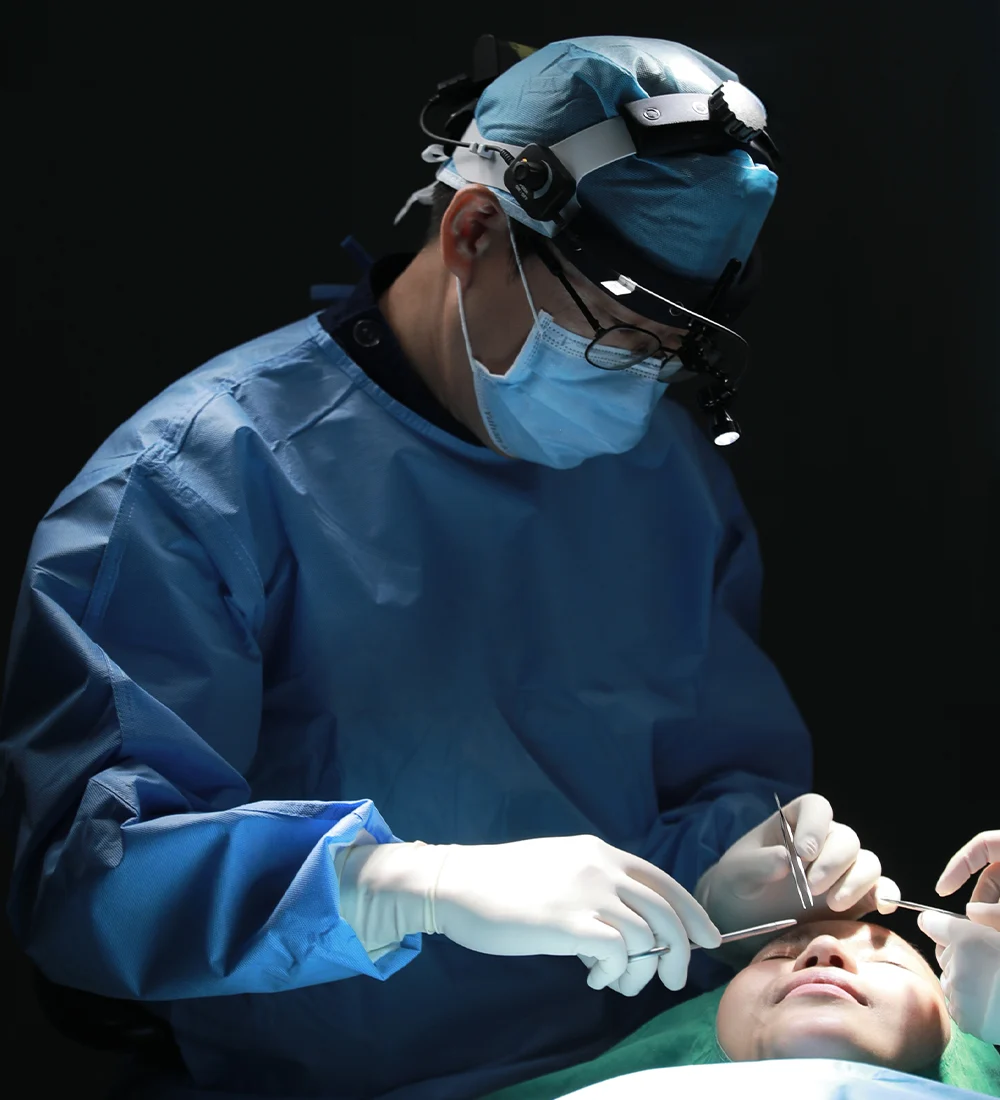
A sub-brow lift removes a strip of skin just under the eyebrow to lift a heavy, hooding upper lid and re-suspend the brow. At Garnet it is planned and performed by one board-certified plastic surgeon, Dr. In-Soo Baek, from consultation through every follow-up.

A sub-brow lift is an eyelid-rejuvenation operation in which a measured strip of skin is excised just below the lower margin of the eyebrow, and the orbicularis muscle beneath it is suspended, so that the heavy, hooding upper lid and the outer brow are elevated. Because the skin is removed at the brow rather than in the lid crease, the eyelid surface is left untouched and the scar sits hidden along the brow hair.
A tired, hooded upper eye is not always an eyelid problem. In many people the upper-lid skin looks heavy because the eyebrow itself has descended, pressing redundant skin down over the lid and crowding the outer corner. Treating the lid crease alone in that situation can lower the brow further and is not what the eye needs.
A sub-brow lift addresses the cause from above. A thin strip of skin is removed at the lower edge of the brow and the muscle is re-suspended, which raises the brow tail and lifts the heavy skin off the lid. The result tends to look rested rather than surprised, because the change sits at the brow and keeps the natural lid fold intact.
At Garnet this is a single-surgeon operation. Dr. Baek assesses whether the heaviness is coming from the brow, the lid skin or both, plans the case at consultation, performs it himself and reviews healing at set intervals; the clinic caps the day at two surgeries, so each case has unhurried time. The stated aim is to address the concern you arrived with rather than to over-operate.
From marking the brow strip to orbicularis suspension and a fine closure — every step by Dr. Baek.
A single surgeon, start to finish. Dr. Baek plans the case, performs the operation himself and reviews every follow-up. The clinic caps the day at two surgeries, so each operation has unhurried time.
A sub-brow lift typically takes about 40–60 minutes and is usually carried out under local anaesthesia, with light sedation added for comfort where appropriate; the anaesthesia plan is decided with you at consultation. The steps below outline how the procedure is carried out at Garnet.
Dr. Baek assesses in person whether the heaviness comes from the brow, the lid skin or both, checks brow symmetry and eye-opening, and agrees the exact amount of skin to remove and where the lower line will sit along the brow.
With you sitting upright, the strip to be removed is marked directly under the brow hair so the lower edge of the excision follows the natural brow line and the scar will hide in the hair-bearing margin.
The marked strip of skin (and a thin layer of muscle as needed) is removed precisely under local anaesthesia, lifting the redundant upper-lid skin and the outer brow upward.
The orbicularis muscle is suspended and fixed so the lift is taken by the deeper layer, which supports the elevated brow position rather than relying on the skin alone.
The skin is closed in fine layers along the brow margin, with the suture line tucked into the lower edge of the brow hair to keep it discreet.
Because Garnet is single-surgeon, Dr. Baek reviews you himself before you settle in, removes sutures around day 7 and checks healing at each follow-up.
The position of the eyebrow is held by a balance: the frontalis muscle lifts it, while the orbicularis, corrugator and depressor muscles pull it down, and a set of retaining structures anchor the soft tissue to the orbital rim. As these loosen with age, the brow — especially the outer third — descends and its skin folds down over the upper lid. The lateral orbital and orbicularis retaining ligaments are central to how the brow and lid are tethered to the bone (Mendelson, Aesthetic Plast Surg 2013; DOI 10.1007/s00266-013-0066-8).
A sub-brow excision works precisely on this layer: removing skin at the brow margin and suspending the orbicularis re-tensions the descended outer brow and lifts the hood off the lid without disturbing the levator mechanism that opens the eye. In a series of sub-brow procedures for mild-to-moderate brow ptosis, patients reported high satisfaction with both functional and aesthetic results and minimal early complications (Int Ophthalmol 2025; DOI 10.1007/s10792-025-03858-y). Where the upper lid itself also carries excess skin or a weak opening, an upper blepharoplasty or ptosis correction may be planned alongside.
| Sub-brow lift | Upper blepharoplasty | Forehead lift | |
|---|---|---|---|
| Where skin is removed | Under the eyebrow | In the upper-lid crease | Scalp / hairline (no lid skin) |
| Main cause it treats | Descended brow / outer hood | Excess eyelid skin | Whole-forehead & brow descent |
| Effect on the brow | Lifts & re-suspends | Little direct change | Greatest elevation |
| Scar position | Along the brow margin | Hidden in the lid fold | Within the scalp / hairline |
| Typical use | Heavy lid from a low brow | Heavy lid from lid skin | Marked, generalised brow drop |
Brow descent is a recognised contributor to a heavy upper lid, and the right operation depends on where the heaviness comes from (Int Ophthalmol 2025; DOI 10.1007/s10792-025-03858-y). Dr. Baek determines which approach — or combination — fits your anatomy at consultation.
A sub-brow lift is usually performed under local anaesthesia, with light sedation added for comfort where appropriate over a roughly 40–60 minute procedure. Your medical history is reviewed beforehand and the plan is decided with you.
Because Garnet caps the day at two surgeries, the procedure is unhurried and the same surgeon who planned the case carries it out and reviews recovery — there is no separate operating doctor and no rotation of care.
Garnet is registered with Korea's foreign-patient programme; pre-operative checks, scheduling and after-care are coordinated for international visitors in English.
If a sub-brow lift is not the right answer — for example if the heaviness is mostly lid skin or needs an eye-opening adjustment — that is said at consultation. Photos can be reviewed before you travel.
The incision for a sub-brow lift is placed immediately below the lower border of the eyebrow, so the line settles into the margin of the brow hair. Tucking the closure against the hair-bearing edge is one of the factors associated with a scar that is difficult to notice once it matures, particularly when brows are kept in their natural shape.
Scars are permanent and, in the early weeks, the line may look pink before it fades. Healing varies by individual and skin type; visibility is greater in those who wear the brows very high or thin. Dr. Baek reviews scar maturation at the 1-, 3- and 6-month visits and advises on scar care and sun protection.
Sub-brow lift before/after sets are identifiable and are reviewed privately at consultation with consent, rather than published. Results, recovery and suitability vary by individual and are not guaranteed.
Keep the head elevated, use cold compresses early, take medication as prescribed, keep the brow area clean and dry as instructed, and keep your follow-up visits.
Rubbing or stretching the brow, strenuous exercise and heavy lifting early on, alcohol and smoking, very hot showers/saunas, and direct sun on the healing scar until cleared.
A sub-brow lift makes a lasting structural change, because it removes skin and re-suspends the muscle rather than relying on a temporary tightening. In a published series of sub-brow excision for mild-to-moderate brow ptosis, patients reported high functional and aesthetic satisfaction at follow-up with minimal complications (Yazıcıoğlu et al, Int Ophthalmol 2025; DOI 10.1007/s10792-025-03858-y).
No procedure stops ageing, and the brow and lid continue to change slowly over the years; tissue quality, sun exposure and weight change all play a part. Garnet's approach is to lift conservatively so the result sits naturally from the start. Where the eye later develops separate concerns, options such as an upper blepharoplasty can be considered independently.
Where the lid itself also carries excess skin, an upper blepharoplasty can be planned in the same sitting so both the brow and the lid skin are addressed in balance.
If the eye-opening muscle is weak, ptosis correction treats the underlying cause of a tired look that a skin lift alone would not fix.
Lower-lid concerns such as eye-bags can be addressed separately with under-eye fat repositioning when the lower eye is part of the picture.
For marked, generalised brow descent rather than an isolated outer hood, a forehead lift may give a more proportionate elevation and is discussed at consultation.
Every operation carries risk. For a sub-brow lift the main considerations are scar visibility along the brow margin, temporary asymmetry of the brows, and short-lived numbness above the line as small sensory nerves recover. In published sub-brow series, early complications were generally minor and temporary, such as redness and swelling (Int Ophthalmol 2025; DOI 10.1007/s10792-025-03858-y).
Less common issues include over- or under-correction, a scar that stays pink longer in some skin types, and — uncommonly — a persistent sensory change near the incision. Smoking raises wound-healing risk. These are explained individually at consultation so expectations are clear before surgery.
What reduces risk in practice: careful selection of who genuinely benefits from a brow-level lift versus a lid procedure, conservative skin removal, a closure tucked into the brow margin, and follow-up by the operating surgeon. Garnet's single-surgeon, low-volume model is built around this kind of unhurried planning and personal after-care.
Most international patients plan roughly 7–10 days in Korea for a sub-brow lift, so sutures can be removed by the surgeon around day 7 and the early swelling has settled before travel. The coordinator confirms the timing for your specific plan.
Before you travel, send clear photos (front, and a relaxed view with the brows in their natural position) and a note on your concern and dates through WhatsApp, LINE or the form below. You'll get an honest pre-assessment — including whether a brow lift or a lid procedure suits you — rather than a hard sell.
Garnet is registered with Korea's foreign-patient programme and coordinates consultations, scheduling and after-care in English. After you return home, Dr. Baek can continue to review your recovery by messenger.
| Sub-brow lift | Upper blepharoplasty | Forehead lift | |
|---|---|---|---|
| Where skin is removed | Under the eyebrow | In the upper-lid crease | Scalp / hairline (no lid skin) |
| Main cause it treats | Descended brow / outer hood | Excess eyelid skin | Whole-forehead & brow descent |
| Effect on the brow | Lifts & re-suspends | Little direct change | Greatest elevation |
| Scar position | Along the brow margin | Hidden in the lid fold | Within the scalp / hairline |
| Typical use | Heavy lid from a low brow | Heavy lid from lid skin | Marked, generalised brow drop |
Citations are provided for general education. This page is informational and does not replace an in-person consultation; suitability, technique and recovery are individual.
Send photos and your question before you travel. An English-speaking coordinator reviews every enquiry and replies with honest guidance on whether surgery is appropriate, the likely plan and timing.
Prefer to chat now? Reach the coordinator directly: