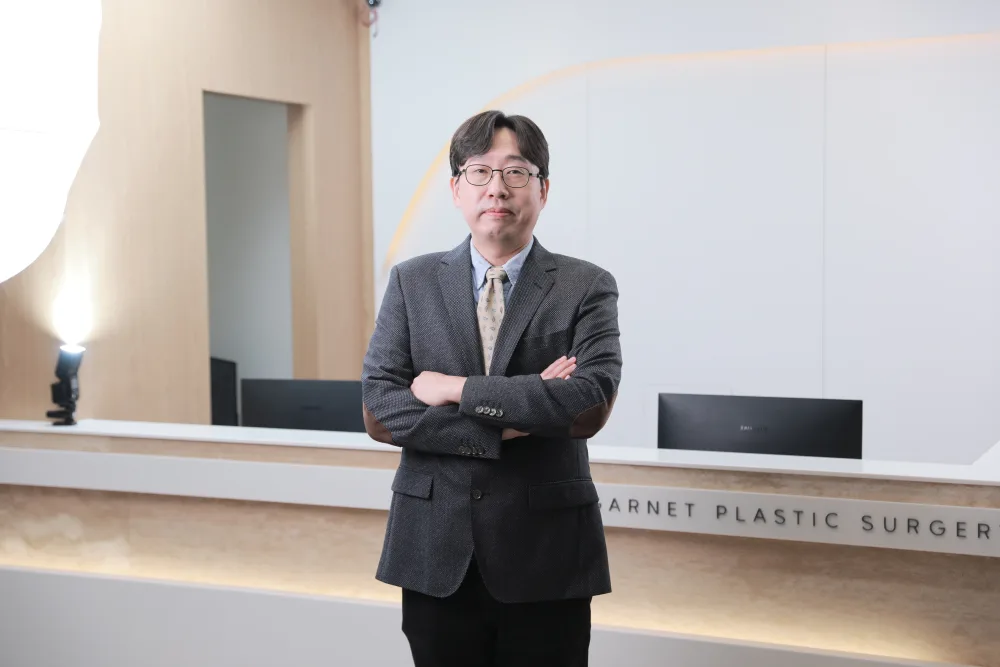
Stem cell fat grafting transfers your own fat, supplemented with the cell-rich stromal fraction taken from the same harvest, to restore lost facial volume. At Garnet it is planned and performed by one board-certified plastic surgeon, Dr. In-Soo Baek, from consultation through every follow-up.
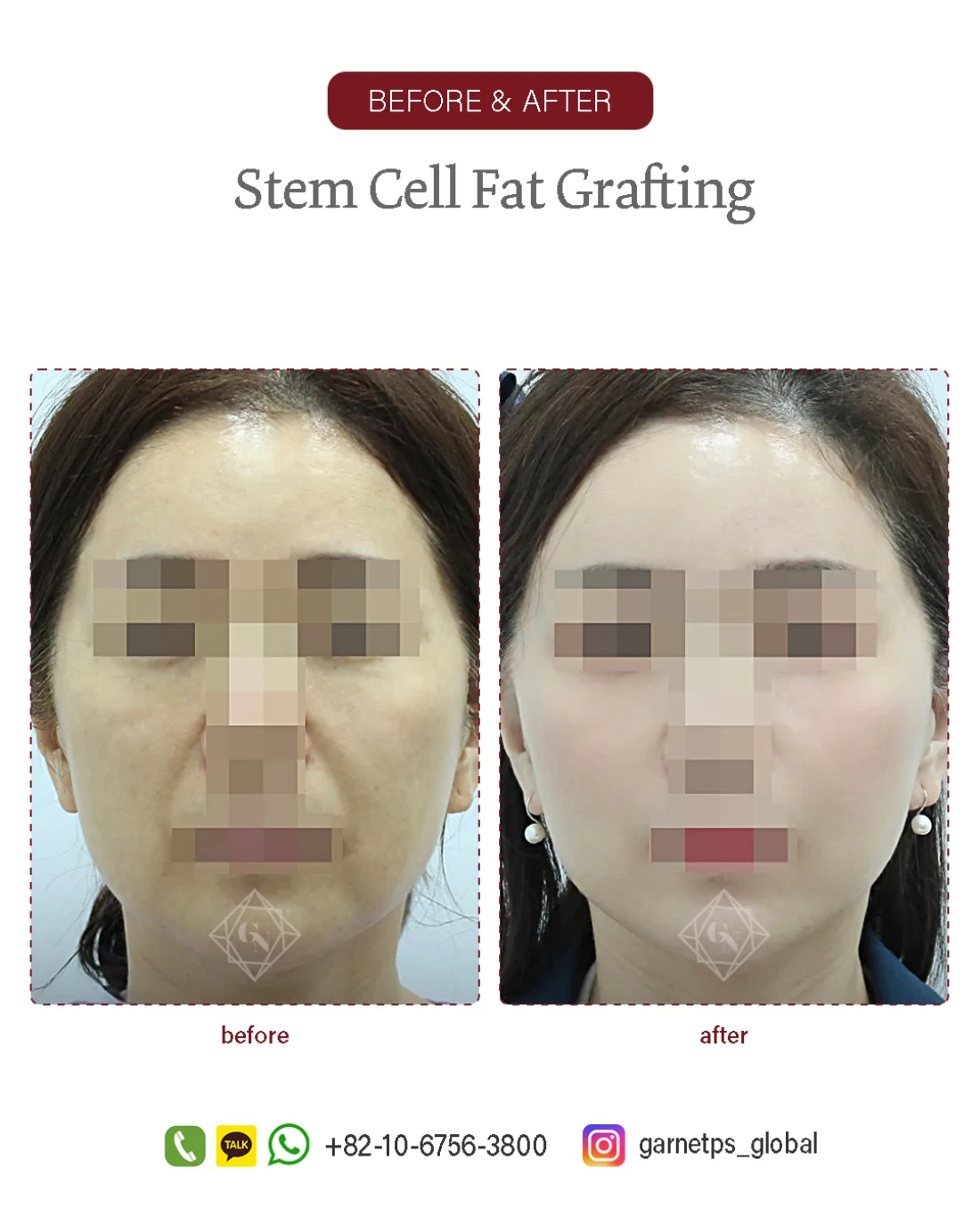
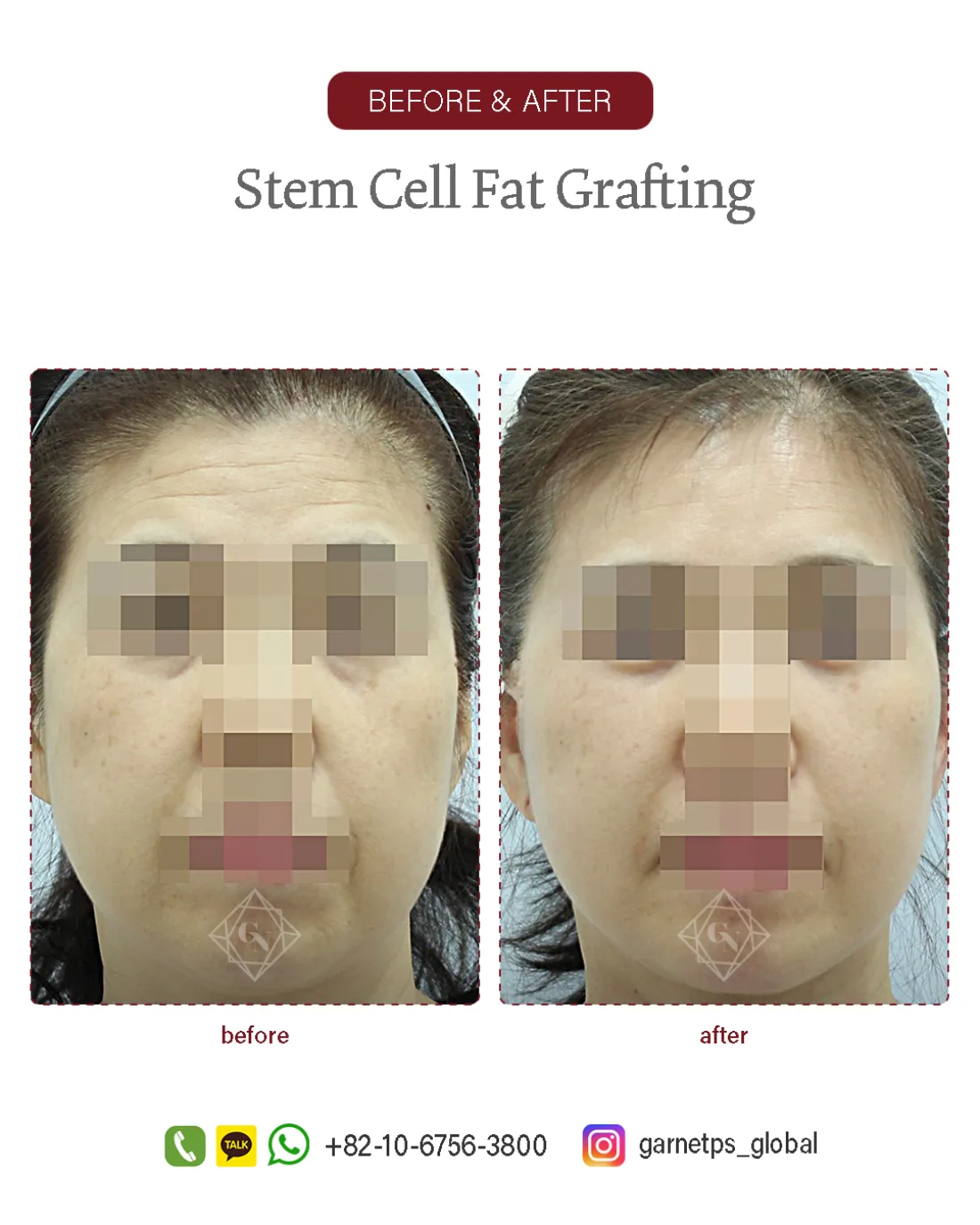
Fat-grafting and contouring results of actual Garnet patients (published with consent, with date, procedure and clinic labelled). Results, the amount of fat retained, recovery and suitability vary by individual and are not guaranteed.

Stem cell fat grafting is a fat-transfer procedure in which fat harvested from one part of the body is processed and re-injected into the face to replace lost volume, with the cell-rich stromal vascular fraction separated from the same harvest added to the graft. It is sometimes described as cell-assisted or stromal-fraction-supplemented fat grafting, and the transferred tissue is entirely your own.
As the face ages, part of the change is loss of volume — the cheeks flatten, the temples and under-eye hollow, and the face can read as tired rather than only lax. Fat grafting addresses this directly by replacing the lost fat with soft tissue of your own, which integrates with the surrounding tissue rather than sitting on top of it as a synthetic material would.
The 'stem cell' or stromal-fraction approach adds the cell-rich portion separated from the same harvested fat back into the graft. Adipose tissue naturally contains a mixed population of cells — the stromal vascular fraction — and the rationale is that re-adding this fraction may support the grafted fat. Garnet describes the technique factually: it is the clinic's stromal-fraction-supplemented fat grafting, not a designated advanced-regenerative-medicine treatment, and no superior survival or efficacy is promised.
At Garnet this is a single-surgeon procedure. Dr. Baek plans the case from the consultation, harvests and places the fat himself, and reviews healing at set intervals; the clinic caps the day at two surgeries so each case has unhurried time. The stated aim is to address the volume concern you arrived with, not to over-fill.
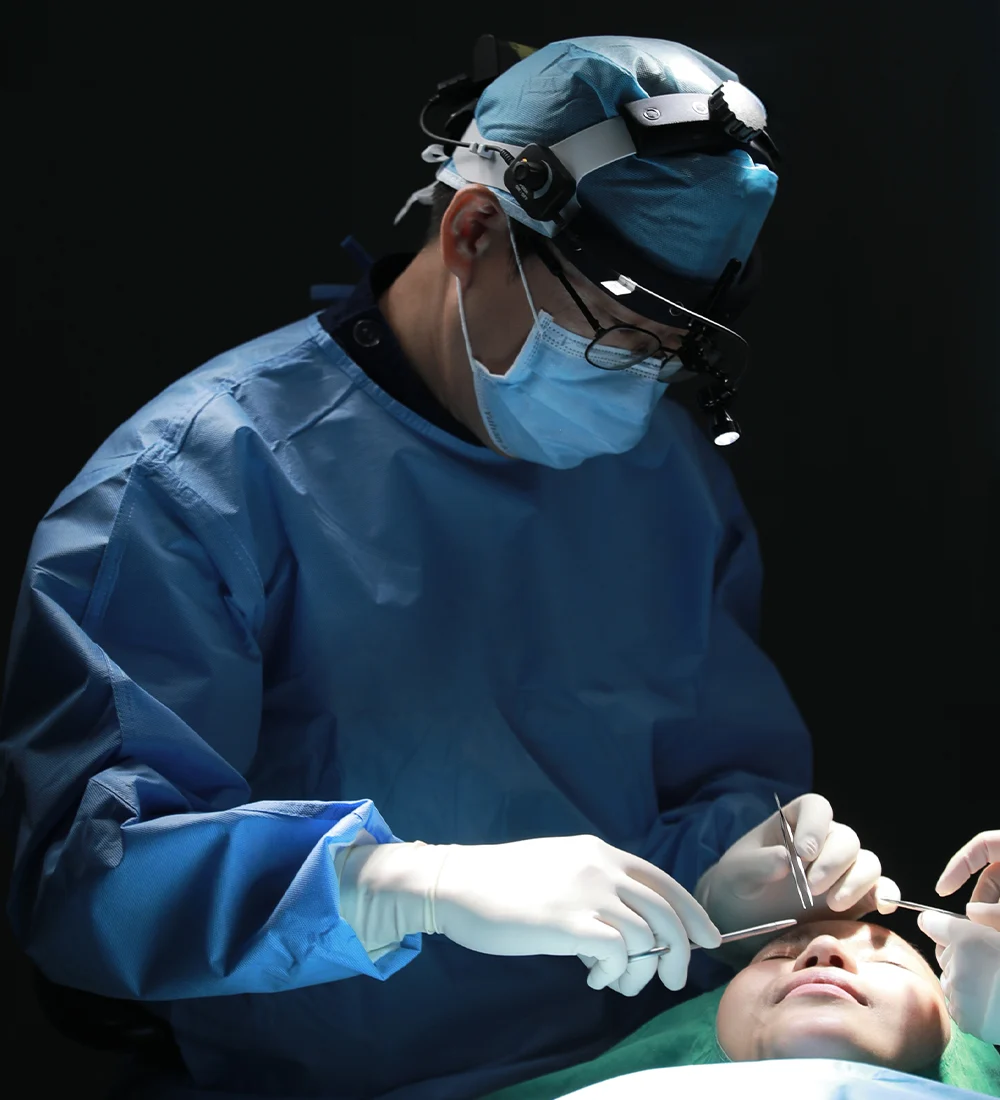
From the fat harvest and processing to layered placement — every step by Dr. Baek.
A single surgeon, start to finish. Dr. Baek plans the case, performs the operation himself and reviews every follow-up. The clinic caps the day at two surgeries, so each operation has unhurried time.
The procedure typically runs about one to two hours, under local anaesthesia with sedation as appropriate, decided with you after your medical history is reviewed; the clinic does not specify a single fixed anaesthetic, so the plan is confirmed at consultation. The steps below outline how the graft is harvested, prepared and placed at Garnet.
Dr. Baek assesses the areas of volume loss and the available donor sites (commonly the abdomen or thigh), and agrees the plan with you — how much to harvest and where to place it. Photographs are taken for the record.
Fat is gently aspirated through fine cannula access points at the donor site, using a low-trauma technique intended to keep the fat cells viable for transfer.
The harvested fat is processed, and the cell-rich stromal vascular fraction separated from the same harvest is prepared and added to the graft. This is done within the operation from your own tissue.
The prepared fat is placed in small parcels at multiple levels through fine cannula points, so each parcel sits close to a blood supply — the factor most associated with survival — rather than as one large pocket.
Where the consultation shows it, grafting is planned alongside neck and chin contouring or a thread lift so volume and contour are balanced together.
Light dressing over the access points. Because Garnet is single-surgeon, Dr. Baek reviews you himself and at each follow-up, when early settling and any need for a touch-up are assessed.
Grafted fat has no blood supply of its own at the moment it is placed; in the first days it survives by diffusion from the surrounding tissue until new vessels grow in. Fat that is too far from a blood supply does not survive, which is why a portion of any graft is reabsorbed in the early months and why the surgeon places small parcels of fat at multiple levels rather than one large pocket. Reported resorption across the literature is wide, broadly in the range of 20–80% depending on technique and site (J Tissue Eng Regen Med 2018; DOI 10.1002/term.2524).
The stromal vascular fraction added to the graft is the non-fat-cell portion of the harvest, which includes cells thought to support new vessel formation. Reviews report that fraction- or stem-cell-supplemented grafting can be associated with higher retention than plain grafting in some settings (Aesthetic Plast Surg 2026; DOI 10.1007/s00266-025-05511-6), though results vary by study and by patient. Garnet plans the harvest and placement for each face individually; for fixed structural sag rather than volume loss, a thread lift or surgical lifting may be more appropriate.
| Standard fat grafting | Stem cell fat grafting | Synthetic filler | |
|---|---|---|---|
| Material | Your own fat | Your own fat + its stromal fraction | Manufactured gel (e.g. HA) |
| Permanence | Surviving fat persists | Surviving fat persists | Temporary, reabsorbed |
| Donor site needed | Yes | Yes | No |
| Early reabsorption | A portion reabsorbs | A portion reabsorbs | Gradual over months |
| Best for | Volume loss | Volume loss | Smaller, adjustable fill |
A network meta-analysis of assisted fat-grafting methods is published in Aesthetic Plast Surg 2024 (DOI 10.1007/s00266-024-04060-8). Garnet is not designated for advanced regenerative medicine and makes no superior-survival claim; the right choice is individual and is discussed with Dr. Baek at consultation.
Fat grafting is typically performed under local anaesthesia, with light sedation added as appropriate for comfort over a one-to-two-hour procedure. The exact plan is decided with you after your medical history is reviewed; no single fixed anaesthetic is assumed in advance.
Because Garnet caps the day at two surgeries, the procedure is unhurried and the same surgeon who planned the case harvests, enriches and places the fat and reviews recovery — there is no separate operating doctor.
Garnet is registered with Korea's foreign-patient programme; pre-procedure checks, scheduling and after-care are coordinated for international visitors in English.
If grafting is not appropriate, or a filler or lifting option suits you better, that is said at the consultation. Photos can be reviewed before you travel.
Stem cell fat grafting is carried out through fine cannula access points at both the donor site and the face, rather than through a surgical incision with a suture line. These entry points are small and are placed discreetly, and they typically fade over the weeks that follow.
Healing varies by individual and by skin type. Bruising at the donor and recipient sites is common early on and settles over one to two weeks. Dr. Baek reviews the access points and the donor area at the 1-, 3- and 6-month visits and advises on care.
Use cold compresses early, take medication as prescribed, keep the donor area clean, eat and hydrate well to support healing, and keep your follow-up visits.
Strenuous exercise and heavy lifting early on, firm pressure or massage on the grafted area unless advised, alcohol and smoking, and very hot showers or saunas until cleared.
Fat grafting is partly a long-term procedure and partly not: a proportion of any grafted fat is reabsorbed in the first months, while the fat that establishes a blood supply tends to persist. Reported survival varies widely between studies and patients, and adding the stromal fraction is associated with higher retention in some reviews (Laloze et al., J Tissue Eng Regen Med 2018; DOI 10.1002/term.2524), though no specific figure can be promised for an individual.
How much fat is retained depends on tissue quality, the area treated, technique and lifestyle factors such as weight change and smoking. Garnet's approach is to place the graft conservatively and review settling over months, with a touch-up discussed only if wanted. Because the tissue is your own, the fat that survives ages with you rather than wearing off like a temporary filler.
Volume restoration is often planned with Pelican™ double-chin and neck contouring, so the lower face and neck are balanced in the same plan.
A thread lift can address early laxity that grafting alone does not, where mild repositioning as well as volume is part of the concern.
Where the stromal-fraction step is not indicated, conventional fat grafting uses the same harvest-and-place principle and is discussed as an alternative.
Grafting to the under-eye is sometimes combined with eyelid procedures where hollowing and lid concerns occur together; this is assessed at consultation.
Every procedure carries risk. For fat grafting the main considerations are early reabsorption of part of the graft, bruising and swelling, asymmetry, over- or under-correction (sometimes needing a touch-up), and — uncommonly — small firm areas, fat cysts or infection. Because Garnet is not designated for advanced regenerative medicine, no superior survival or efficacy is claimed; the stromal-fraction step is described factually only.
Donor-site effects such as bruising and temporary tenderness are usual and settle. As with any procedure that places tissue into the face, rare vascular complications are recognised in the broader literature and are minimised by careful, layered technique. Smoking and uncontrolled medical conditions raise risk and are reviewed individually at consultation (Aesthetic Plast Surg 2024; DOI 10.1007/s00266-024-04060-8).
What reduces risk in practice: careful patient selection, low-trauma harvesting, placing the fat in small parcels close to a blood supply, conservative volumes, and follow-up by the operating surgeon. Garnet's single-surgeon, low-volume model is built around exactly this kind of unhurried planning and personal after-care.
Most international patients plan roughly 7–10 days in Korea for stem cell fat grafting, so the early bruising has settled and the surgeon can review the result before travel. The coordinator confirms the timing for your specific plan.
Before you travel, send clear photos (front, three-quarter and side) and a note on the areas you would like addressed and your dates through WhatsApp, LINE or the form below. You'll get an honest pre-assessment — including whether grafting is appropriate — rather than a hard sell.
Garnet is registered with Korea's foreign-patient programme and coordinates consultations, scheduling and after-care in English. After you return home, Dr. Baek can continue to review your settling by messenger.
| Standard fat grafting | Stem cell fat grafting | Synthetic filler | |
|---|---|---|---|
| Material | Your own fat | Your own fat + its stromal fraction | Manufactured gel (e.g. HA) |
| Permanence | Surviving fat persists | Surviving fat persists | Temporary, reabsorbed |
| Donor site needed | Yes | Yes | No |
| Early reabsorption | A portion reabsorbs | A portion reabsorbs | Gradual over months |
| Best for | Volume loss | Volume loss | Smaller, adjustable fill |
Citations are provided for general education. This page is informational and does not replace an in-person consultation; suitability, technique and recovery are individual.
Send photos and your question before you travel. An English-speaking coordinator reviews every enquiry and replies with honest guidance on whether surgery is appropriate, the likely plan and timing.
Prefer to chat now? Reach the coordinator directly: