Garnet Plastic Surgery · Apgujeong, Seoul — one board-certified surgeon, eye · nose · lifting
Procedures
Eye Surgery
Lower blepharoplasty Upper blepharoplasty Non-incision double eyelid Incision double eyelid Ptosis correction Epicanthoplasty Lateral canthoplasty Under-eye fat repositioning Sub-brow / brow lift Round eye correction
Rhinoplasty
Rhinoplasty Implant-free rhinoplasty Revision rhinoplasty Rib-cartilage rhinoplasty Septal/ear-cartilage rhinoplasty
Facial Lifting
Mini facelift Deep mini facelift™ Full facelift Neck lift
Forehead & Brow
Forehead lift Forehead reduction
Fat Grafting & Contouring
Fat grafting Stem cell fat grafting Pelican™ double-chin & neck contouring Fixpoint Thread Lift™ Neck/cheek/jawline liposuction Corset platysmaplasty
Surgeon Trademarks Before & After Visiting FAQ Book Consultation
Garnet/Fat Grafting & Contouring/Fat grafting (PRP-assisted)
Board-certified Plastic Surgeon · Apgujeong, Seoul

Fat grafting (PRP-assisted) — your own fat, refined and placed to restore lost volume.

Fat grafting restores volume to areas of the face that have hollowed - the under-eye, temples, cheeks or lips - using your own fat, harvested from the abdomen or thigh, refined into micro-fat and placed in small amounts. At Garnet it is planned and performed by one board-certified plastic surgeon, Dr. In-Soo Baek, from consultation through every follow-up.

Your own
fat, PRP-assisted
Micro-fat
refined, placed in layers
1
surgeon, every step
Anaesthesia
Local / sedation (as appropriate)
Surgery time
~1-2 hours
Sutures out
Minimal (cannula access)
Social downtime
~1-2 weeks (swelling)
Follow-up
1 / 3 / 6 months
10,000+ fat-grafting cases since 2011· Board-certified plastic surgeon — accredited member, Korean Society of Plastic & Reconstructive Surgeons· Foreign-patient programme registered· Single-surgeon practice

The bottom line

What it is
A volume-restoring procedure that takes your own fat from the abdomen or thigh, processes it into fine micro-fat (supplemented with PRP from your own blood), and grafts it in small amounts to hollow areas of the face.
Best for
Volume loss with age - flat or hollow under-eyes, temples, cheeks or lips - and refining contour where the issue is lost fullness rather than sagging skin.
Who performs it
Dr. In-Soo Baek only - a board-certified plastic surgeon and Garnet's sole operating doctor. The same surgeon consults, operates and follows up.
Downtime
Cannula access means minimal visible scarring; most swelling and bruising settle over roughly 1-2 weeks, with the final volume set once early swelling has resolved.
Longevity
A proportion of grafted fat resorbs in the first months and the surviving fat is long-lasting; reported facial volume retention varies widely (Aesthetic Plast Surg 2021).
How to start
Send photos through WhatsApp or the form below for an honest, no-obligation pre-assessment before you travel.
Candidacy What it is How it's performed The science Fat grafting vs filler Anaesthesia & safety Access & marks Before & after Recovery Longevity Combining Risks International patients FAQ

Is it right for you?

Often a good fit

  • Volume loss with age - hollow under-eyes, flat temples, deflated cheeks or thin lips
  • A wish to restore fullness using your own tissue rather than a synthetic filler
  • Enough donor fat at the abdomen or thigh to harvest
  • General good health and realistic expectations about graft survival
  • Able to plan around 1-2 weeks for swelling and the follow-up schedule

Worth discussing other options

  • Mainly sagging skin rather than lost volume - lifting may suit better
  • Wanting a precise, easily reversible touch-up only - a filler may fit better
  • Very little donor fat available - assessed at consultation
  • Uncontrolled medical conditions - assessed individually at consultation
  • Active smoking, which reduces graft survival and raises healing risk - discussed and planned around
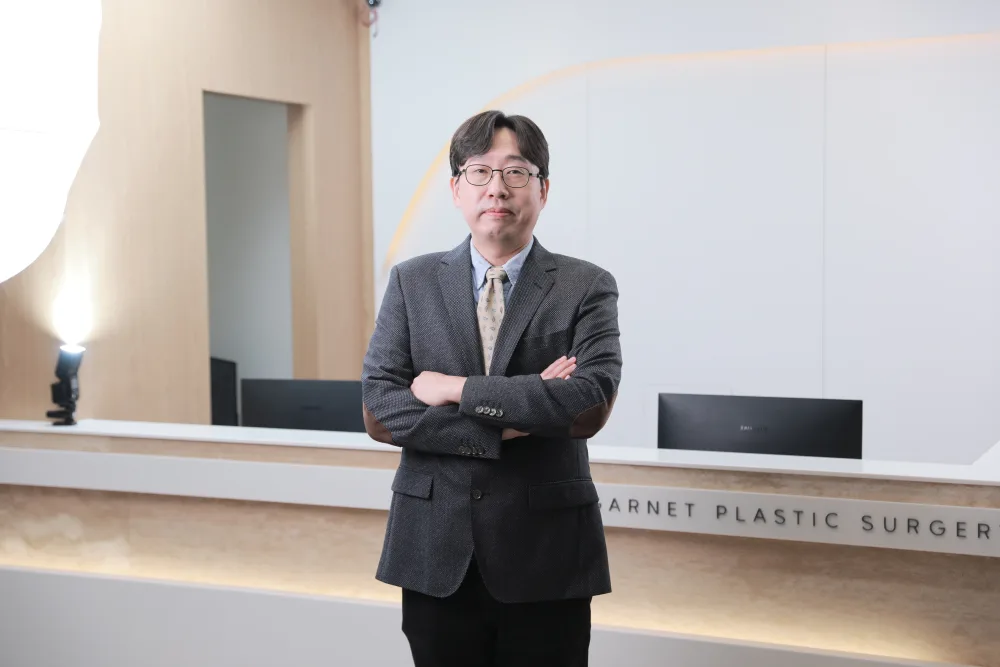
Dr. In-Soo Baek

Dr. In-Soo Baek

Director & sole operating surgeon
Korean medical licence no. 77407
  • Board-certified plastic surgeon
  • Korea University College of Medicine & graduate school (plastic surgery)
  • Member, Korean Society of Plastic and Reconstructive Surgeons (facial-contour, eye & rhinoplasty groups)
  • Every case planned, performed and followed up by the same surgeon
About the surgeon →

What patients say

4.8
★★★★★
92 verified patient reviews
Verified visit★★★★★

Garnet is well known for neck-wrinkle and lifting surgery. The facility is excellent and I’m thoroughly satisfied with the friendly consultation and the surgeon’s skill.

S
Song
Neck / lifting
Verified visit★★★★★

Director Baek In-soo, thank you so much. Thanks to you I keep getting told I look younger — it feels like I’ve gone back to my younger days.

V
Verified patient
Facial lifting
Verified visit★★★★★

I had upper and lower eyelid surgery and I’m really satisfied. The director and the manager were both so kind and clear.

V
Verified patient
Eye surgery
Verified visit★★★★★

I started with under-eye fat repositioning — the director and the manager are genuinely kind and good at what they do. I’ll be back.

V
Verified patient
Under-eye
Verified visit★★★★★

I came on a referral and was very satisfied thanks to the doctor’s kind consultation and clear explanations. The nurses were friendly too.

K
Kim
Consultation
Verified visit★★★★★

I kept reading the reviews and came trusting the many mentions of skill and kindness. The clinic was busy with patients and spotless.

V
Verified patient
First visit

Restoring volume with your own refined fat

Fat grafting (autologous fat transfer) is a procedure that restores lost facial volume by harvesting a patient's own fat - usually from the abdomen or thigh - processing it into fine micro-fat, and re-injecting it through a blunt cannula into hollow areas of the face. Because the graft is the patient's own living tissue, the fat that survives integrates and becomes a lasting part of the area.

Much of facial ageing is loss, not just descent: the deep and superficial fat pads of the face deflate, so the under-eye hollows, the temples flatten, the cheeks lose their soft fullness and the face can look tired or gaunt even when the skin is still firm. Lifting addresses sagging, but it does not replace volume that is simply gone.

Fat grafting puts volume back using the patient's own tissue. Fat is harvested gently from the abdomen or thigh, refined into micro-fat - small parcels that pass through a fine cannula and place evenly - and grafted in thin layers so each parcel sits close to a blood supply and has the greatest chance of taking. At Garnet, platelet-rich plasma (PRP) prepared from the patient's own blood is added; supplementing fat grafts has been studied as a way to support volume retention, though results vary (Aesthetic Surg J 2022; DOI 10.1093/asj/sjac122).

At Garnet this is a single-surgeon operation. Dr. Baek plans the case from the consultation - which areas, how much, and whether grafting alone or grafting plus lifting suits you - performs it himself, and reviews healing at set intervals; the clinic caps the day at two surgeries so each case has unhurried time. The aim is natural, balanced restoration of the areas you came concerned about.

One surgeon, one plan

From gentle harvest to micro-fat refinement, PRP and layered placement - every step by Dr. Baek.

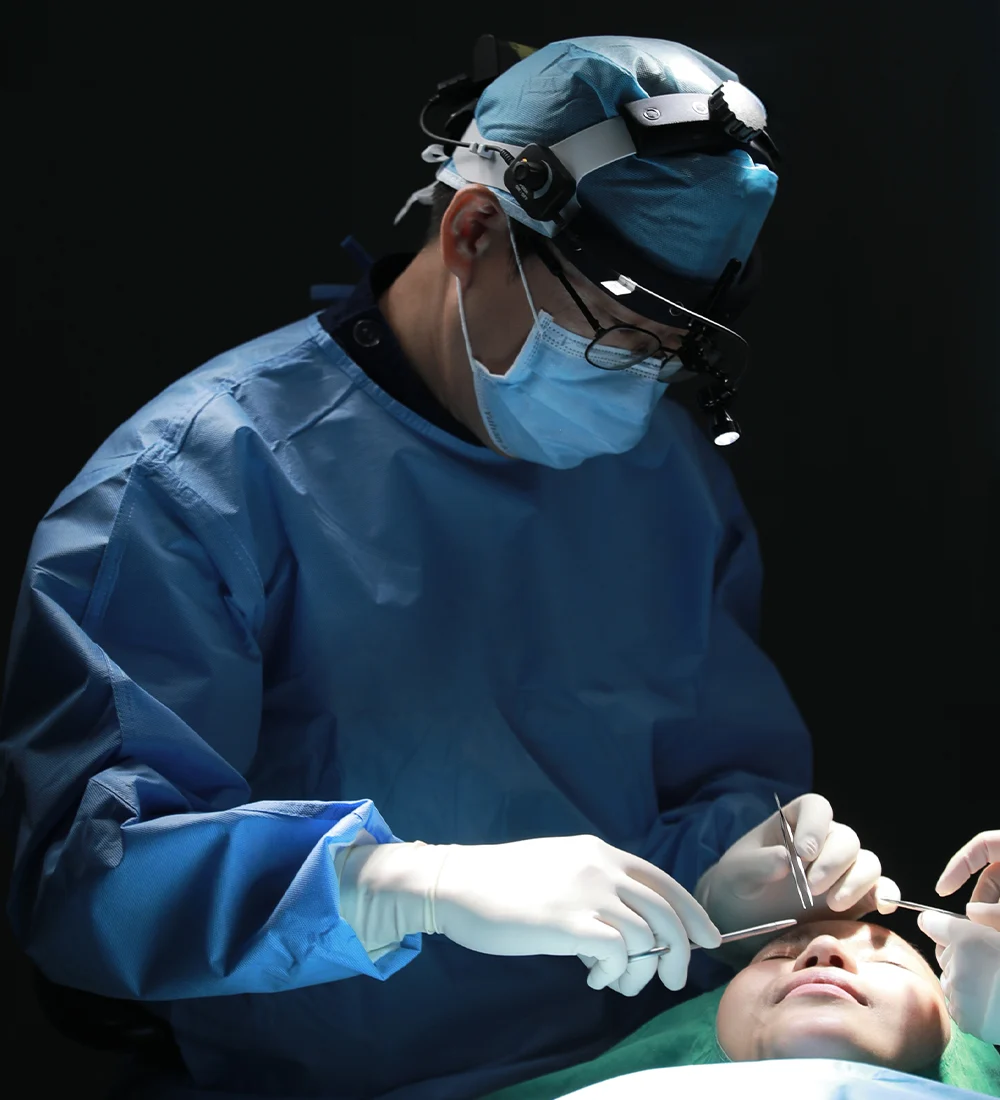
Dr. In-Soo Baek performing surgery at Garnet Plastic Surgery, Apgujeong

A single surgeon, start to finish. Dr. Baek plans the case, performs the operation himself and reviews every follow-up. The clinic caps the day at two surgeries, so each operation has unhurried time.

Facial fat grafting at Garnet typically runs about 1-2 hours and is performed under local anaesthesia with sedation as appropriate, decided with you after your medical history is reviewed; larger or combined cases may use general anaesthesia. The steps below outline how the procedure is carried out.

01

Consultation & planning

Dr. Baek assesses which areas have lost volume - under-eye, temple, cheek or lip - decides how much fat is needed and from where to harvest, and agrees whether grafting alone or grafting with lifting suits your face.

02

Donor harvest

Fat is harvested gently through small cannula access points in the abdomen or thigh, the areas with reliable donor fat, using a technique that aims to keep the fat cells intact for grafting.

03

Processing into micro-fat

The harvested fat is refined into micro-fat - small, clean parcels that pass through a fine cannula - and PRP prepared from your own blood is combined with it before grafting.

04

Layered placement

The micro-fat is grafted through a blunt cannula in thin layers and small amounts, so each parcel sits near a blood supply, which gives the graft a strong chance of surviving and avoids lumpiness.

05

Adjuncts & combining

Where the consultation shows it, grafting is combined with a thread lift, a brow lift or eyelid surgery, since volume loss and sagging often coexist.

06

Review & settling

Access points are tiny and need little or no suturing. Because Garnet is single-surgeon, Dr. Baek reviews you himself before you settle in and at each follow-up as the volume settles.

Why grafted fat takes - or doesn't

A fat graft is living tissue moved without its own blood supply, so in the first days it survives by diffusion from the surrounding bed until new vessels grow in. This is why how the fat is handled matters: gentle harvest, careful processing into small parcels, and placement in thin layers rather than large pockets all give each graft parcel access to a blood supply. Fat placed too thickly in one spot is more likely to resorb or form a lump.

Because not all grafted fat survives, a proportion resorbs over the first few months and the volume that remains after that is durable. Reported facial volume-retention rates vary widely across studies and depend on technique and the area treated (Aesthetic Plast Surg 2021; DOI 10.1007/s00266-020-01612-6), which is why Dr. Baek plans conservatively, sometimes graduating the volume, and reviews the settled result. Where the concern is sagging rather than lost volume, lifting such as a thread lift or surgical lift is discussed instead of or alongside grafting.

Fat grafting vs dermal filler

Fat graftingHyaluronic-acid fillerCombined / staged
MaterialYour own fatGel injectedBoth, by area
ProcedureHarvest + graftIn-clinic injectionSurgery + injectable
LongevitySurviving fat is lastingMonths to a year-plusMixed by area
Volume capacityLarger areas at onceSmaller, precise touch-upsTailored
ReversibilityNot reversibleOften dissolvableDepends

Reported facial fat-graft volume retention varies widely between studies (Aesthetic Plast Surg 2021; DOI 10.1007/s00266-020-01612-6). Fat grafting and fillers suit different goals; the right choice - or a staged combination - is individual and Dr. Baek advises at consultation.

How your safety is handled

Anaesthesia

Facial fat grafting is commonly performed under local anaesthesia with sedation as appropriate, decided with you and the team for comfort over the procedure; larger or combined cases may use general anaesthesia. Your medical history is reviewed beforehand.

Single-surgeon monitoring

Because Garnet caps the day at two surgeries, the procedure is unhurried and the same surgeon who planned the case carries it out and reviews recovery - there is no separate operating doctor and no rotation of care.

Foreign-patient programme

Garnet is registered with Korea's foreign-patient programme; pre-operative checks, scheduling and after-care are coordinated for international visitors in English.

Honest assessment

If your concern is sagging rather than lost volume, or a filler would suit better, that is said at the consultation. Photos can be reviewed before you travel.

Access points, not incisions

Fat grafting is carried out through cannula access points rather than open incisions: small entry points in the abdomen or thigh for harvest, and tiny entry points on the face for placement. These need little or no suturing and generally heal as small marks rather than a scar line, so there is usually no visible incision scar from the grafting itself.

The donor area may be bruised and a little tender for a couple of weeks, and the grafted areas swell while the fat settles. Healing varies by individual; Dr. Baek reviews the donor and recipient sites at the 1-, 3- and 6-month visits and advises on care as the graft matures.

Before & After

Fat grafting before/after sets are reviewed privately at consultation, as faces are identifiable and results settle over months. Graft survival, final volume, recovery and suitability vary by individual and are not guaranteed.

Request before & after examples privately

Week by week

Days 1-3
Swelling and bruising at the grafted areas and the donor site build then peak over the first few days; the face can look fuller than the final result because of swelling. Rest with the head elevated, cold compresses as advised; the team reviews you before you settle in.
Days 4-7
Swelling begins to turn the corner and bruising starts to fade. Gentle walking is encouraged. The donor area may stay tender; avoid pressure on the grafted areas as advised.
Week 1-2
Most visible swelling and bruising settle over this period, though the grafted areas continue to refine. Many international patients plan their stay so the surgeon reviews them before travel.
Weeks 2-6
The face looks more natural as swelling resolves; a proportion of the grafted fat resorbs over the first months, so the volume gradually finds its settled level.
Months 1-6
The surviving graft stabilises and the final volume becomes clear over the following months. Dr. Baek reviews healing at one, three and six months - in person, or by messenger after you return home.

Do

Keep the head elevated early, use cold compresses as advised, take medication as prescribed, eat and stay well-nourished to support graft survival, and keep your follow-up visits.

Avoid

Pressure, massage or sleeping face-down on the grafted areas early on, strenuous exercise, alcohol and smoking, very hot showers/saunas, and aggressive facials until cleared.

How long does it last?

Fat grafting has two phases: in the first few months a proportion of the grafted fat resorbs, and the fat that survives becomes a lasting, integrated part of the area - because it is the patient's own living tissue, not a temporary gel. Reported facial volume-retention rates vary widely across studies and depend on technique and the area treated (Aesthetic Plast Surg 2021; DOI 10.1007/s00266-020-01612-6).

Because some resorption is expected, Dr. Baek plans conservatively and reviews the settled result, and a second, smaller session is sometimes discussed if more volume is wanted. Adding PRP has been studied as a way to support retention, with mixed evidence (Aesthetic Surg J 2022; DOI 10.1093/asj/sjac122). The grafted fat can still change with significant weight gain or loss, and skin-surface ageing continues independently.

Often planned together

Thread lift

Volume loss and mild sagging often coexist; fat grafting and a thread lift can be planned together so fullness and a gentle lift are addressed in one sitting.

Brow / forehead lift

Grafting to a hollow temple complements a brow lift, restoring upper-face volume that lifting alone does not replace.

Eyelid & under-eye

Fat grafting can soften a hollow under-eye, and is sometimes considered with eyelid surgery; whether grafting, repositioning or both suits you is decided at consultation.

Stem-cell-assisted grafting

Garnet also offers stem cell fat grafting as a related option; the appropriate approach for your tissue is discussed honestly, without efficacy guarantees.

An honest word on risk

Every procedure carries risk. For fat grafting the common, usually temporary effects are swelling and bruising at both the grafted areas and the donor site, and tenderness of the donor area, which settle over weeks. Because grafted fat resorbs partly, under- or over-correction can occur, and the final volume is judged only once swelling has resolved.

Less common risks include firm lumps or oil cysts in over-filled areas, contour irregularity, asymmetry, infection, and donor-site changes. A rare but serious risk specific to facial fat injection is inadvertent intravascular injection, which is minimised by using a blunt cannula, low-pressure layered placement and careful technique. Smoking reduces graft survival and raises healing risk. These are explained individually at consultation.

What reduces risk in practice: gentle harvest, refined micro-fat, layered placement near a blood supply, conservative volumes, and follow-up by the operating surgeon. Garnet's single-surgeon, low-volume model is built around exactly this kind of unhurried planning and personal after-care; Garnet makes no graft-survival or regenerative-superiority guarantee.

Planning from abroad

Most international patients plan roughly 7-14 days in Korea for facial fat grafting, so the surgeon can review the grafted and donor areas before travel and the early swelling has settled. The coordinator confirms the timing for your specific plan.

Before you travel, send clear photos (front, three-quarter and side, relaxed) and a note on the areas that concern you and your dates through WhatsApp, LINE or the form below. You'll get an honest pre-assessment - including whether grafting, a filler or lifting fits best - rather than a hard sell.

Garnet is registered with Korea's foreign-patient programme and coordinates consultations, scheduling and after-care in English. After you return home, Dr. Baek can continue to review your recovery and the settling volume by messenger.

Guides for international patients

Questions about this procedure

Where is the fat taken from for facial fat grafting?
Donor fat is harvested gently through small cannula access points, usually from the abdomen or thigh, as these have reliable fat for grafting. The fat is refined into fine micro-fat and combined with PRP from your own blood before it is grafted into the face.
What is the difference between fat grafting and filler?
Fat grafting uses your own fat, harvested and grafted, so the surviving fat is lasting; a hyaluronic-acid filler is an injected gel that lasts months to a year-plus and is often dissolvable. Fat grafting suits larger volume restoration, fillers suit precise touch-ups.
Fat graftingHyaluronic-acid fillerCombined / staged
MaterialYour own fatGel injectedBoth, by area
ProcedureHarvest + graftIn-clinic injectionSurgery + injectable
LongevitySurviving fat is lastingMonths to a year-plusMixed by area
Volume capacityLarger areas at onceSmaller, precise touch-upsTailored
ReversibilityNot reversibleOften dissolvableDepends
Does Dr. Baek perform the surgery himself?
Yes. Garnet is a single-surgeon practice, so Dr. Baek handles the consultation, the harvest, the grafting and the follow-up personally - there is no separate operating doctor and no rotation of care, and the day is capped at two surgeries.
How long does facial fat grafting last?
A proportion of the grafted fat resorbs in the first months, and the fat that survives is long-lasting because it is your own living tissue. Reported volume retention varies widely between studies, so Dr. Baek plans conservatively and reviews the settled result.
How long should I stay in Korea?
Most international patients plan about 7-14 days, so the surgeon can review the grafted and donor areas and early swelling settles before travel. The coordinator confirms timing for your plan and any combined procedures.
What anaesthesia is used and how much pain is there?
Commonly local anaesthesia with sedation as appropriate; larger or combined cases may use general anaesthesia, decided with you after your history is reviewed. Most patients describe tenderness at the donor area rather than sharp pain, managed with prescribed medication.
Will there be scars from fat grafting?
The procedure uses cannula access points, not open incisions, so there is usually no visible scar line - just tiny entry marks that fade. The donor area at the abdomen or thigh may bruise and feel tender for a couple of weeks.
Does adding PRP make a difference?
PRP, prepared from your own blood, is added to support graft retention. Studies of supplementing fat grafts show mixed results, so Garnet uses it as part of careful technique rather than as a guaranteed outcome; this is explained honestly at consultation.
Can fat grafting fix sagging skin?
Not on its own. Fat grafting restores lost volume; sagging is better addressed by lifting such as a thread lift or surgical lift. Where both volume loss and sagging are present, grafting and lifting can be planned together.
When can I exercise again?
Gentle walking early; strenuous exercise waits a couple of weeks and is cleared at follow-up, as heat, sweating and raised blood pressure early on can increase swelling and may affect graft settling.
Can I combine fat grafting with a lift?
Yes. Grafting is commonly combined with a thread lift or a brow lift, since volume loss and sagging often coexist; the plan is set with you at consultation.
How is this different from stem cell fat grafting?
Standard fat grafting places refined micro-fat with PRP. Stem cell fat grafting is a related option discussed for some cases; Garnet describes it without efficacy-superiority or graft-survival guarantees, as appropriate for your tissue.
What are the main risks?
Common effects are temporary swelling and bruising at the grafted and donor areas. Less common risks include lumps in over-filled areas, asymmetry and, rarely, intravascular injection - minimised by blunt-cannula, layered technique. These are discussed individually at consultation.
Can I see fat grafting before-and-after photos?
Faces are identifiable and results settle over months, so full sets are reviewed privately at consultation with consent rather than published. Contouring examples from other procedures are shown on this site.
How do I start without flying to Korea first?
Send photos and the areas that concern you, with your dates, through WhatsApp, LINE or the form below. You'll get an honest pre-assessment - including whether grafting, a filler or lifting fits best - before you plan a trip.

Sources

  1. Lv Q, Li X, Qi Y, et al. Volume Retention After Facial Fat Grafting and Relevant Factors: A Systematic Review and Meta-analysis. Aesthetic Plast Surg. 2021. DOI 10.1007/s00266-020-01612-6. link
  2. Vyas KS, et al. Supplementation of Facial Fat Grafting to Increase Volume Retention: A Systematic Review. Aesthetic Surg J. 2022. DOI 10.1093/asj/sjac122. link
  3. Coleman SR. Structural Fat Grafting: More Than a Permanent Filler. Plast Reconstr Surg. 2006. DOI 10.1097/01.prs.0000234610.81672.e7. link

Citations are provided for general education. This page is informational and does not replace an in-person consultation; suitability, technique and recovery are individual.

Ask Dr. Baek’s team

Send photos and your question before you travel. An English-speaking coordinator reviews every enquiry and replies with honest guidance on whether surgery is appropriate, the likely plan and timing.

  • Reviewed by the clinic coordinator, not a bot
  • Photo-based pre-assessment before you fly
  • Foreign-patient scheduling & after-care
  • One surgeon for consultation, surgery and follow-up

Prefer to chat now? Reach the coordinator directly:

Request a consultation

  • WhatsApp
  • LINE
  • WeChat
  • Telegram
  • Email
  • Eye surgery
  • Rhinoplasty
  • Facial lifting
  • Forehead & brow
  • Fat grafting & contouring
  • Revision

Submits in real time to Garnet’s Supabase intake (branch: garnet). Your details are handled per our privacy policy.

Book consultation