Garnet Plastic Surgery · Apgujeong, Seoul — one board-certified surgeon, eye · nose · lifting
Procedures
Eye Surgery
Lower blepharoplasty Upper blepharoplasty Non-incision double eyelid Incision double eyelid Ptosis correction Epicanthoplasty Lateral canthoplasty Under-eye fat repositioning Sub-brow / brow lift Round eye correction
Rhinoplasty
Rhinoplasty Implant-free rhinoplasty Revision rhinoplasty Rib-cartilage rhinoplasty Septal/ear-cartilage rhinoplasty
Facial Lifting
Mini facelift Deep mini facelift™ Full facelift Neck lift
Forehead & Brow
Forehead lift Forehead reduction
Fat Grafting & Contouring
Fat grafting Stem cell fat grafting Pelican™ double-chin & neck contouring Fixpoint Thread Lift™ Neck/cheek/jawline liposuction Corset platysmaplasty
Surgeon Trademarks Before & After Visiting FAQ Book Consultation
Garnet/Eye Surgery/Ptosis correction
Board-certified Plastic Surgeon · Apgujeong, Seoul

Ptosis correction — a tired, low-sitting lid raised by tuning the muscle that opens the eye.

Ptosis correction raises an upper eyelid that sits too low by adjusting the strength of the levator — the muscle that opens the eye — so the eye looks more open and alert rather than sleepy. At Garnet it is planned and performed by one board-certified plastic surgeon, Dr. In-Soo Baek, from consultation through every follow-up.

~1–1.5 hrs
operating time
~7 days
sutures out
1
surgeon, every step
Anaesthesia
Local / sedation
Surgery time
~1–1.5 hours
Sutures out
~7 days
Social downtime
~1–2 weeks
Follow-up
1 / 3 / 6 months
10,000+ eye procedures since 2011· Board-certified plastic surgeon — accredited member, Korean Society of Plastic & Reconstructive Surgeons· Foreign-patient programme registered· Single-surgeon practice

The bottom line

What it is
An eye-opening operation that, through a lid-crease incision, adjusts the strength of the levator muscle (or its aponeurosis) so a low-sitting upper eyelid is raised to a natural height and the eye looks more open.
Best for
A tired, sleepy or asymmetric look caused by the lid margin resting too low — from a stretched or weak levator — rather than from excess skin alone, which is treated differently.
Who performs it
Dr. In-Soo Baek only — a board-certified plastic surgeon and Garnet's sole operating doctor. The same surgeon consults, operates and follows up.
Downtime
Sutures out at about 7 days; most bruising and swelling settle over ~1–2 weeks; the lid height settles fully over a few months.
Longevity
Adjusting the levator gives a lasting result; published series report high satisfaction and accurate lid height, with some cases needing fine adjustment as healing settles.
How to start
Send photos through WhatsApp or the form below for an honest, no-obligation pre-assessment before you travel.
Before & after Candidacy What it is How it's performed The anatomy Ptosis vs upper blepharoplasty Anaesthesia & safety Incisions & scars Recovery Longevity Combining Risks International patients FAQ

Before & After

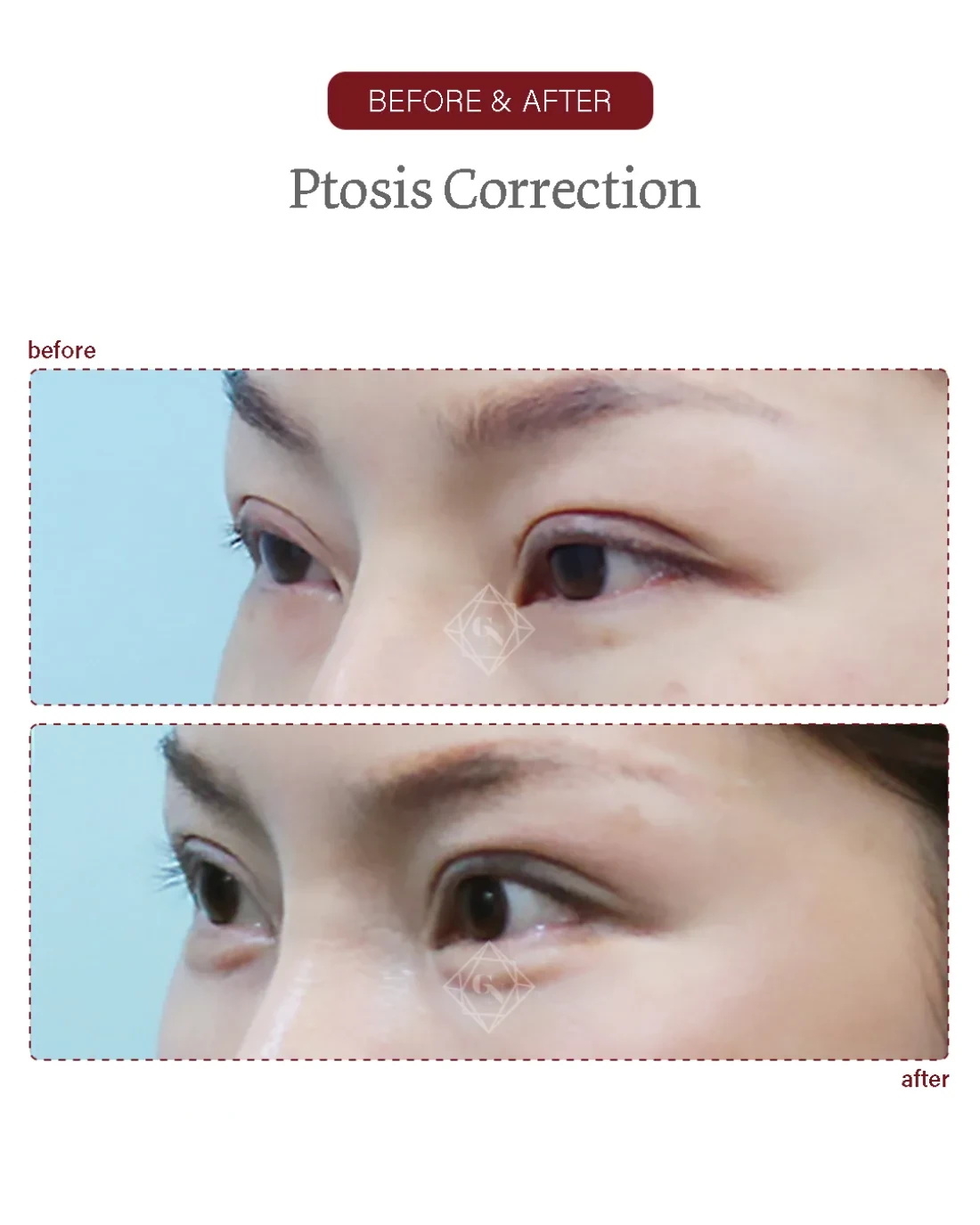
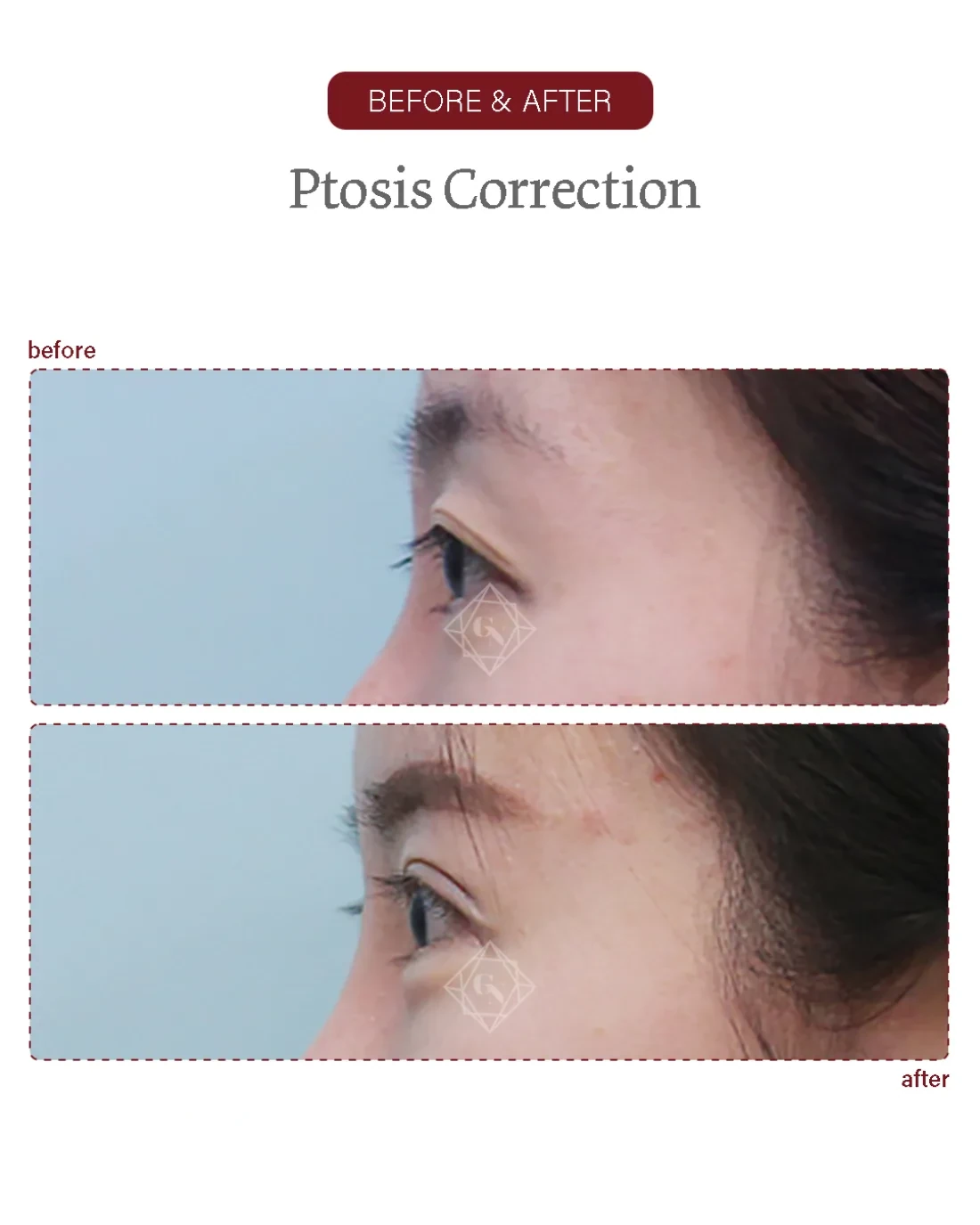
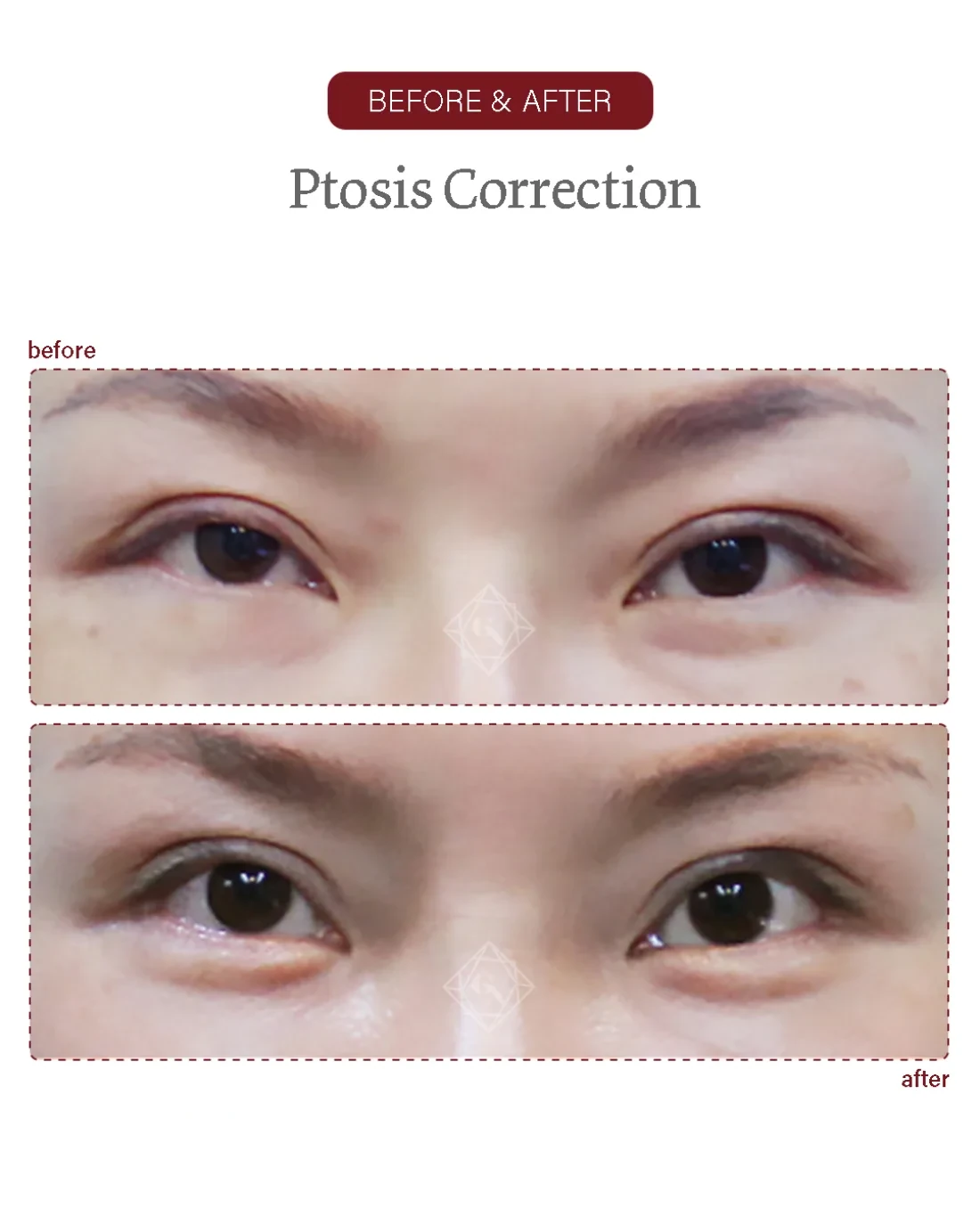
Ptosis-correction before/after examples of actual Garnet patients (published with consent). Results, recovery and suitability vary by individual and are not guaranteed; the right approach is decided at an in-person consultation.

Is it right for you?

Often a good fit

  • A low-sitting upper-lid margin that gives a sleepy or tired look
  • Asymmetry where one eye looks smaller or more covered than the other
  • A habit of lifting the brows or tilting the head back to see better
  • General good health and realistic, discussed expectations
  • Able to plan ~1–2 weeks of social downtime and the follow-up schedule

Worth discussing other options

  • Heaviness that is really excess upper-lid skin — an upper blepharoplasty may suit better
  • Ptosis from a neurological or muscle disorder needing medical work-up first
  • Significant pre-existing dry eye — assessed individually, as raising the lid can affect it
  • Looking for a same-week, no-downtime result
  • Uncontrolled medical conditions — assessed individually at consultation
Dr. In-Soo Baek

Dr. In-Soo Baek

Director & sole operating surgeon
Korean medical licence no. 77407
  • Board-certified plastic surgeon
  • Korea University College of Medicine & graduate school (plastic surgery)
  • Member, Korean Society of Plastic and Reconstructive Surgeons (facial-contour, eye & rhinoplasty groups)
  • Every case planned, performed and followed up by the same surgeon
About the surgeon →

What patients say

4.8
★★★★★
92 verified patient reviews
Verified visit★★★★★

Garnet is well known for neck-wrinkle and lifting surgery. The facility is excellent and I’m thoroughly satisfied with the friendly consultation and the surgeon’s skill.

S
Song
Neck / lifting
Verified visit★★★★★

Director Baek In-soo, thank you so much. Thanks to you I keep getting told I look younger — it feels like I’ve gone back to my younger days.

V
Verified patient
Facial lifting
Verified visit★★★★★

I had upper and lower eyelid surgery and I’m really satisfied. The director and the manager were both so kind and clear.

V
Verified patient
Eye surgery
Verified visit★★★★★

I started with under-eye fat repositioning — the director and the manager are genuinely kind and good at what they do. I’ll be back.

V
Verified patient
Under-eye
Verified visit★★★★★

I came on a referral and was very satisfied thanks to the doctor’s kind consultation and clear explanations. The nurses were friendly too.

K
Kim
Consultation
Verified visit★★★★★

I kept reading the reviews and came trusting the many mentions of skill and kindness. The clinic was busy with patients and spotless.

V
Verified patient
First visit

Tuning the muscle that opens the eye

Ptosis correction is an eyelid operation that raises an upper lid sitting too low (ptosis) by adjusting the strength of the levator palpebrae superioris — the muscle that opens the eye — or its aponeurosis, usually through an incision in the natural lid crease. By tightening or advancing the muscle, the lid margin is reset to a natural height so the eye opens more fully, rather than removing skin as a blepharoplasty does.

Ptosis means the upper-lid margin rests lower than it should, partly covering the iris and giving a sleepy, tired or uneven look; people often compensate by lifting their brows or tilting the head back. The usual cause in adults is a levator aponeurosis that has stretched or thinned with age, contact-lens wear or previous surgery, so the muscle no longer lifts the lid to its full height.

Ptosis correction works on the eye-opening mechanism itself, not the skin. Through a lid-crease incision the levator muscle or its aponeurosis is tightened or advanced by a measured amount so the lid margin sits where it should. Because the target height is judged finely — often with you cooperating during the operation under local anaesthesia — getting the symmetry right is the central challenge, and a small later adjustment is sometimes part of the plan.

At Garnet this is a single-surgeon operation. Dr. Baek plans the case from the consultation, performs it himself and reviews healing at set intervals; the clinic caps the day at about two surgeries so each case has unhurried time. The stated aim is to address the concern you arrived with and to prevent foreseeable complications, rather than to chase the maximum possible change.

One surgeon, one plan

From the crease-line incision and measured levator adjustment to fine symmetry control — every step by Dr. Baek.

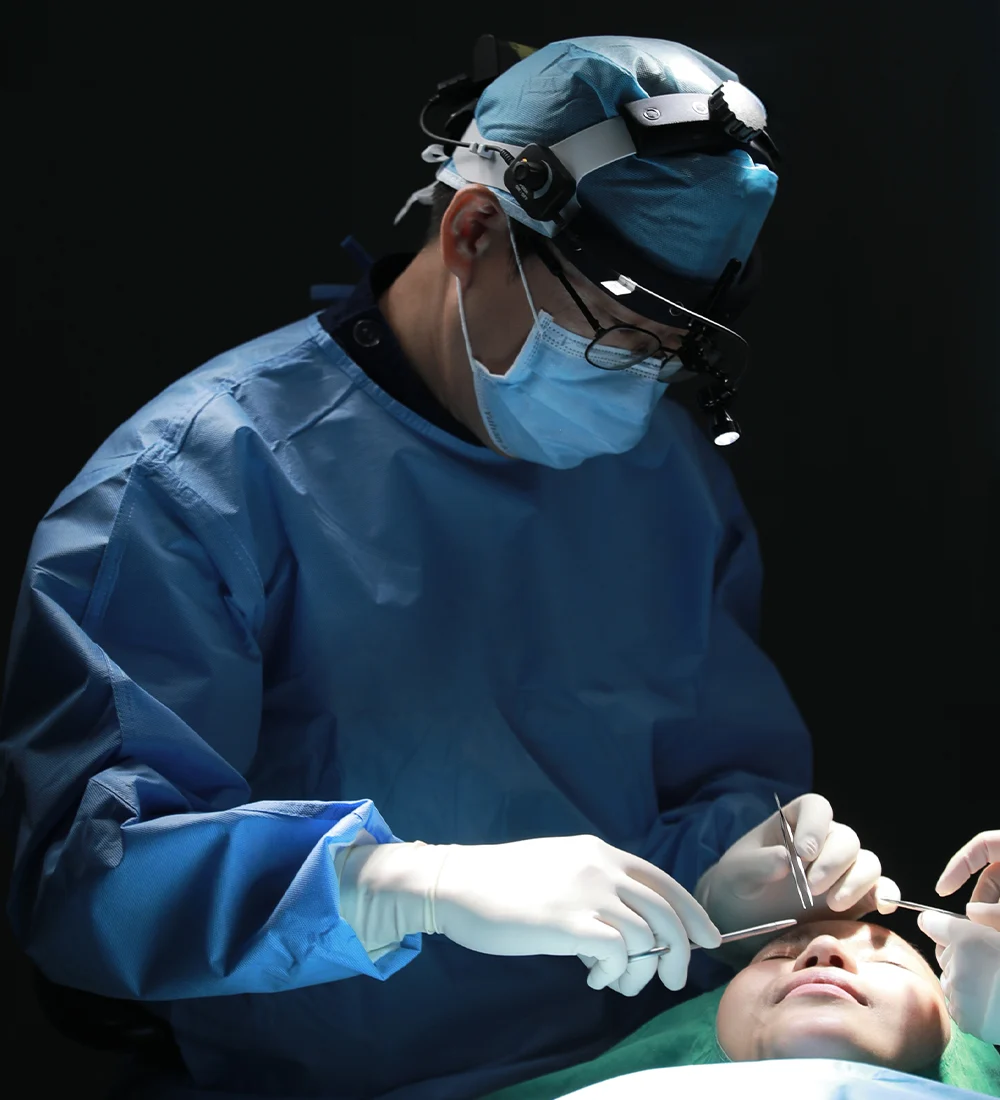
Dr. In-Soo Baek performing surgery at Garnet Plastic Surgery, Apgujeong

A single surgeon, start to finish. Dr. Baek plans the case, performs the operation himself and reviews every follow-up. The clinic caps the day at two surgeries, so each operation has unhurried time.

Ptosis correction at Garnet typically runs about one to one-and-a-half hours, usually under local anaesthesia with sedation as appropriate, decided with you after your medical history is reviewed; light anaesthesia lets you cooperate so lid height can be checked during surgery. The steps below outline how it is carried out.
01

Consultation & planning

Dr. Baek assesses the lid in person — how low the margin sits, how well the levator works, the crease and any compensatory brow lift — and agrees the plan with you. Levator function and the degree of droop guide how much adjustment is planned.

02

Crease-line incision

An incision is placed in the natural upper-lid crease, where the scar settles into the fold and is hidden when the eye is open. This route gives access to the levator aponeurosis and lets the crease be re-formed neatly.

03

Levator adjustment

The levator aponeurosis is advanced or tightened by a measured amount so the lid margin is raised to its target height. The amount is judged finely against the planned position for a natural, not startled, opening.

04

Symmetry check

With light anaesthesia you can be asked to open your eyes so the lid height and contour are checked against the other side and fine-tuned during the operation — the step that most affects a symmetric result.

05

Crease set & adjuncts

The crease is re-formed at a natural height. Where there is also excess skin, an upper blepharoplasty may be combined; lower-lid concerns can be addressed with lower blepharoplasty in the same sitting.

06

Closure & review

Fine closure with a light dressing. Because Garnet is single-surgeon, Dr. Baek reviews you himself before you settle in and at each follow-up; sutures come out at about seven days.

Why the lid sits low

The upper lid is opened by the levator palpebrae superioris, whose tendon-like aponeurosis attaches to the tarsal plate, with a small smooth muscle (Müller's) assisting. When the aponeurosis stretches, thins or detaches with age, contact-lens wear or prior surgery, the lid margin drops even though the muscle itself may work — this aponeurotic ptosis is the most common adult type. The crease often sits higher than normal as a clue.

Correction restores the lid by advancing or tightening the levator aponeurosis a measured amount, referenced from its anatomy, so the margin reaches a natural height; structured pre-operative assessment improves how predictable that height is (Plast Reconstr Surg 2023; DOI 10.1097/PRS.0000000000010889). Because ptosis is a muscle problem, removing skin alone — an upper blepharoplasty — will not raise a low lid margin; the consultation distinguishes the two so the right operation, or a combination, is planned.

Ptosis correction vs upper blepharoplasty vs non-incision

Ptosis correctionUpper blepharoplastyNon-incision (suture) method
Problem treatedLow lid margin (weak levator)Excess upper-lid skinMild ptosis, thin lid, no excess skin
What it adjustsThe eye-opening muscleRemoves redundant skinLevator via buried sutures
Raises the lid margin?YesNo — lightens the hood onlyYes, for milder cases
ScarHidden in the lid creaseHidden in the lid creaseNo skin incision
Typical candidateSleepy, low-sitting lidLoose lid skin, normal lid heightMild droop, suitable lid anatomy

The choice turns on whether a low lid margin (a muscle problem) or excess skin is the cause — and ptosis with hooding may need both. Structured levator assessment improves how accurately lid height is set (Plast Reconstr Surg 2023; DOI 10.1097/PRS.0000000000010889). Where it is mainly excess skin, an upper blepharoplasty is planned instead; Dr. Baek advises at consultation.

How your safety is handled

Anaesthesia

Ptosis correction is usually performed under local anaesthesia with light sedation, decided with you for comfort over a one-to-one-and-a-half-hour operation. Lighter anaesthesia is often preferred so you can open your eyes on request and lid height can be checked during surgery. Your medical history is reviewed beforehand.

Single-surgeon monitoring

Because Garnet caps the day at about two surgeries, the operation is unhurried and the same surgeon who planned the case carries it out and reviews recovery — there is no separate operating doctor and no rotation of care.

Foreign-patient programme

Garnet is registered with Korea's foreign-patient programme; pre-operative checks, scheduling and after-care are coordinated for international visitors in English.

Honest assessment

If the issue is really excess skin rather than a low lid margin, that is said at the consultation and the right operation planned. Photos can be reviewed before you travel.

Where the scar sits

Incisional ptosis correction uses an incision placed in the natural upper-lid crease, so the resulting scar sits within the fold and is hidden when the eye is open. Closed with fine sutures and following the existing crease, it usually settles into a thin, inconspicuous line as it matures, much like a double-eyelid or upper-blepharoplasty scar.

Scars are permanent but designed to disappear into the crease; healing varies by individual and skin type, and an early pink line softens over the following months. For milder ptosis with a thin lid and no excess skin, a non-incision suture method may avoid a skin incision altogether — discussed at consultation. Dr. Baek reviews scar maturation at the 1-, 3- and 6-month visits and advises on scar care.

Week by week

Days 1–3
A light dressing or tapes over the crease line; swelling and bruising build then peak over the first few days, and the lid may feel tight. Rest with the head elevated and use cold compresses as advised. Discomfort is usually mild and managed with prescribed medication.
Days 4–7
Swelling begins to turn the corner and bruising starts to fade. Sutures are removed at about day seven by the surgeon. The eyes may not yet look fully even while swelling is present — this is expected early on.
Weeks 1–2
Residual swelling continues to ease and lid height becomes clearer; light cover make-up away from the incision helps for everyday settings. Reading and screen work resume as comfort allows.
Weeks 2–4
Most social downtime is over for everyday settings. Lid height and symmetry keep refining as the last swelling resolves; it is too early to judge the final result.
Months 1–6
Lid height settles to its final position and the scar matures over the following months. Dr. Baek reviews healing at one, three and six months and judges whether any fine adjustment is needed — in person, or by messenger after you return home.

Do

Keep the head elevated, use cold compresses early, take medication and any eye drops or lubricant as prescribed, sleep on your back, and keep your follow-up visits.

Avoid

Rubbing the eyes, strenuous exercise and heavy lifting early on, alcohol and smoking, very hot showers/saunas, eye make-up on the incision until cleared, and direct sun on the healing scar.

How long does it last?

Ptosis correction gives a lasting result because the levator is reset to lift the lid to its proper height; published series using structured levator assessment report high satisfaction and accurate lid height at follow-up (Plast Reconstr Surg 2023; DOI 10.1097/PRS.0000000000010889). Once healed and symmetric, most patients do not need a repeat for many years.

Because the target height is fine and tissues continue to settle, a small later adjustment is sometimes part of the plan, particularly in more severe or asymmetric cases. Over the long term the aponeurosis can stretch again slowly with age, and a habit of brow-lifting eases once the lid sits correctly. Garnet's approach is careful intra-operative height setting so the result looks natural and symmetric from the start.

Often planned together

Upper blepharoplasty

Where there is also excess upper-lid skin, an upper blepharoplasty is commonly planned in the same sitting, so the hood is lifted while the lid margin is raised.

Double-eyelid surgery

Ptosis correction is often planned with an incision double-eyelid, since the same crease-line approach can open the eye and define the crease together.

Non-incision option

For milder ptosis with a thin lid and no excess skin, a non-incision (suture) method can adjust the levator without a skin incision, discussed at consultation.

Lower eyelid surgery

Where the lower lids are also a concern, lower blepharoplasty can be combined so the whole eye area is balanced in one recovery.

An honest word on risk

Every operation carries risk. The defining challenge of ptosis correction is height and symmetry: the corrected lid can end up slightly under- or over-raised, or a little uneven with the other side, which is why height is checked during surgery and why a small later adjustment is sometimes planned. In series using structured levator assessment, lid height is set accurately in most cases, but fine adjustment is part of managing the rest (Plast Reconstr Surg 2023; DOI 10.1097/PRS.0000000000010889).

Other possible risks include temporary swelling and bruising, dryness or watering (raising the lid can expose more of the eye surface), temporarily incomplete closure, scar-related issues and, rarely, a change in lid contour. Pre-existing dry eye is assessed beforehand. These are explained individually at consultation.

What reduces risk in practice: confirming the diagnosis is truly aponeurotic ptosis rather than skin or a medical cause, measuring levator function, checking height intra-operatively, and follow-up by the operating surgeon who can make any fine adjustment. Garnet's single-surgeon, low-volume model is built around exactly this kind of unhurried planning and personal after-care. Results are intended improvements, not guarantees.

Planning from abroad

Most international patients plan roughly 7–10 days in Korea for ptosis correction, so sutures can be removed by the surgeon at about day seven and the early swelling has settled before travel. Because lid height takes time to settle, the coordinator confirms the timing for your specific plan.

Before you travel, send clear photos (eyes relaxed and looking straight ahead, eyes gently closed, and a three-quarter view) and a note on your concern and dates through WhatsApp, LINE or the form below. You'll get an honest pre-assessment — including whether the issue is the muscle or excess skin — rather than a hard sell.

Garnet is registered with Korea's foreign-patient programme and coordinates consultations, scheduling and after-care in English. After you return home, Dr. Baek can continue to review your recovery, and judge any fine adjustment, by messenger.

Guides for international patients

Questions about this procedure

What does ptosis correction do?
It raises an upper eyelid that sits too low by adjusting the strength of the levator — the muscle that opens the eye — usually through a lid-crease incision. The lid margin is reset to a natural height so the eye looks more open and alert, rather than removing skin as a blepharoplasty does.
How is ptosis correction different from an upper blepharoplasty?
They treat different causes. Ptosis correction adjusts the eye-opening muscle to raise a low-sitting lid margin; an upper blepharoplasty removes excess upper-lid skin and lightens hooding but does not raise the margin. Many people have both a low margin and loose skin, in which case the two are combined. Which you need is judged at consultation by assessing the lid margin, the levator and the skin.
Ptosis correctionUpper blepharoplastyNon-incision (suture) method
Problem treatedLow lid margin (weak levator)Excess upper-lid skinMild ptosis, thin lid, no excess skin
What it adjustsThe eye-opening muscleRemoves redundant skinLevator via buried sutures
Raises the lid margin?YesNo — lightens the hood onlyYes, for milder cases
ScarHidden in the lid creaseHidden in the lid creaseNo skin incision
Typical candidateSleepy, low-sitting lidLoose lid skin, normal lid heightMild droop, suitable lid anatomy
Does Dr. Baek perform the surgery himself?
Yes. Garnet is a single-surgeon practice, so Dr. Baek handles the consultation, the operation and the follow-up personally — there is no separate operating doctor and no rotation of care.
Why am I awake or lightly sedated during the surgery?
Light anaesthesia lets you open your eyes on request so lid height and symmetry can be checked and fine-tuned during the operation. That cooperation is one of the most reliable ways to set an even, natural result, and it is explained beforehand.
How much does ptosis correction cost in Korea?
Fees depend on the degree of ptosis and what is combined with it, so a price is given only after an in-person assessment. Send photos through the form below for guidance, and ask the coordinator about current pricing rather than relying on a generic figure.
How long is recovery after ptosis correction?
Sutures come out at about day seven, and most bruising and swelling settle over one to two weeks for everyday settings. Lid height keeps refining for some weeks, and the final, settled position develops over the following months.
Where is the scar and will it show?
Incisional ptosis correction uses an incision in the natural lid crease, so the scar hides in the fold and is not visible when the eye is open. For milder cases a non-incision suture method may avoid a skin incision altogether, which is assessed at consultation.
Will my eyes be symmetric afterwards?
That is the central aim, which is why height is checked during surgery with your cooperation. Early on the eyes may look uneven while swelling is present; the final symmetry is judged once healing settles, and a small adjustment is sometimes planned for severe or asymmetric cases.
Am I a good candidate for ptosis correction?
It often suits a low-sitting, sleepy or asymmetric lid in someone in good health with realistic expectations. Ptosis from a neurological or muscle disorder needs medical work-up first, and marked dry eye is assessed individually — bring this up at consultation.
Can I combine it with double-eyelid or upper-lid surgery?
Yes. An incision double-eyelid or an upper blepharoplasty is commonly planned in the same sitting where the consultation shows it, since the same crease-line approach can open the eye and refine the lid together.
Could correction cause dry eyes?
Raising the lid exposes a little more of the eye surface, so temporary dryness or watering can occur and is usually managed with drops. Pre-existing dry eye is assessed beforehand, since it influences how much correction is appropriate; this is discussed at consultation.
How long should I stay in Korea?
Most international patients plan about 7–10 days, so sutures can be removed by the surgeon and early swelling settles before travel. Because lid height takes time to settle, the coordinator confirms timing for your plan and any combined procedures.
Is the result permanent?
It is long-lasting, since the levator is reset to lift the lid properly. The aponeurosis can stretch again slowly over many years with ageing, but most patients do not need a repeat for a long time; long-term outcomes are discussed at consultation.
Can I see ptosis-correction before-and-after photos?
Yes — ptosis-correction before/after examples are shown on this page and reviewed in more detail at consultation with consent. Results vary by individual, so they illustrate rather than promise an outcome.
How do I start without flying to Korea first?
Send photos and your dates through WhatsApp, LINE or the form below. You'll get an honest pre-assessment — including whether the cause is the muscle or excess skin — before you plan a trip.

Sources

  1. Upper Eyelid Ptosis Correction with Levator Advancement Using the Levator Musculoaponeurotic Junction Formula. Plast Reconstr Surg. 2023. DOI 10.1097/PRS.0000000000010889. link
  2. Upper Eyelid Blepharoplasty: Surgical Techniques and Results — Systematic Review and Meta-analysis. Aesthetic Plast Surg. 2023. DOI 10.1007/s00266-023-03436-6. link
  3. Alhumaemydi R, Diab MM, AlSuhaibani AH. Refining transcutaneous lower blepharoplasty: Key steps for minimizing complications. Saudi J Ophthalmol. 2025. DOI 10.4103/sjopt.sjopt_89_25. link

Citations are provided for general education. This page is informational and does not replace an in-person consultation; suitability, technique and recovery are individual.

Ask Dr. Baek’s team

Send photos and your question before you travel. An English-speaking coordinator reviews every enquiry and replies with honest guidance on whether surgery is appropriate, the likely plan and timing.

  • Reviewed by the clinic coordinator, not a bot
  • Photo-based pre-assessment before you fly
  • Foreign-patient scheduling & after-care
  • One surgeon for consultation, surgery and follow-up

Prefer to chat now? Reach the coordinator directly:

Request a consultation

  • WhatsApp
  • LINE
  • WeChat
  • Telegram
  • Email
  • Eye surgery
  • Rhinoplasty
  • Facial lifting
  • Forehead & brow
  • Fat grafting & contouring
  • Revision

Submits in real time to Garnet’s Supabase intake (branch: garnet). Your details are handled per our privacy policy.

Book consultation