Garnet Plastic Surgery · Apgujeong, Seoul — one board-certified surgeon, eye · nose · lifting
Procedures
Eye Surgery
Lower blepharoplasty Upper blepharoplasty Non-incision double eyelid Incision double eyelid Ptosis correction Epicanthoplasty Lateral canthoplasty Under-eye fat repositioning Sub-brow / brow lift Round eye correction
Rhinoplasty
Rhinoplasty Implant-free rhinoplasty Revision rhinoplasty Rib-cartilage rhinoplasty Septal/ear-cartilage rhinoplasty
Facial Lifting
Mini facelift Deep mini facelift™ Full facelift Neck lift
Forehead & Brow
Forehead lift Forehead reduction
Fat Grafting & Contouring
Fat grafting Stem cell fat grafting Pelican™ double-chin & neck contouring Fixpoint Thread Lift™ Neck/cheek/jawline liposuction Corset platysmaplasty
Surgeon Trademarks Before & After Visiting FAQ Book Consultation
Garnet/Rhinoplasty/Implant-free rhinoplasty
Board-certified Plastic Surgeon · Apgujeong, Seoul

Implant-free rhinoplasty — a nose built entirely from your own cartilage, with no implant.

Implant-free rhinoplasty reshapes the bridge and tip using only the patient's own cartilage — no silicone or other implant in the nose. At Garnet a board-certified plastic surgeon, Dr. In-Soo Baek, plans and performs every case himself, raising the dorsum with ear cartilage and building the tip with septal cartilage, from consultation through every follow-up.

10,000+
rhinoplasty cases since 2011
0
implants in the nose
1
surgeon, every step
Anaesthesia
Local / sedation
Surgery time
~2 hours
Sutures out
Nose ~7 / ear ~10 days
Social downtime
~1–2 weeks
Follow-up
1 / 3 / 6 months
10,000+ rhinoplasty cases since 2011· Board-certified plastic surgeon — accredited member, Korean Society of Plastic & Reconstructive Surgeons· Foreign-patient programme registered· Single-surgeon practice

The bottom line

What it is
A rhinoplasty that uses only the patient's own cartilage — typically ear cartilage for the bridge and septal cartilage for the tip — so no silicone or other implant is placed in the nose.
Best for
Patients who want added height and a refined tip but prefer to avoid any implant, including those with thin skin or who are wary of long-term implant concerns.
Who performs it
Dr. In-Soo Baek only — a board-certified plastic surgeon and Garnet's sole operating doctor. The same surgeon consults, operates and follows up.
Downtime
Splint and dressings in the first days; nose sutures out at about 7 days and the ear donor site at about 10; most social downtime over by roughly 1–2 weeks; the tip settles over months.
Longevity
A structural change in living autologous tissue; alloplastic dorsal materials carry a recognised complication rate that an all-cartilage nose avoids (Oh et al, 2022).
How to start
Send photos through WhatsApp or the form below for an honest, no-obligation pre-assessment before you travel.
Candidacy What it is How it's performed The anatomy Implant-free vs implant Anaesthesia & safety Incisions & donor site Before & after Recovery Longevity Combining Risks International patients FAQ

Is it right for you?

Often a good fit

  • A wish for a higher bridge and refined tip without any implant in the nose
  • Thin nasal skin, where an implant on the bridge is less ideal
  • A preference for the patient's own tissue and to avoid long-term implant concerns
  • Enough available septal and ear cartilage, confirmed at consultation
  • Able to plan ~1–2 weeks of social downtime plus the donor-site and follow-up schedule

Worth discussing other options

  • Wanting maximum, very controllable dorsal height, where an implant approach may suit better
  • Limited usable cartilage, where a different framework plan is discussed
  • A previously operated nose needing correction, where revision rhinoplasty applies
  • Unrealistic expectations of a nose unlike your facial proportions
  • Uncontrolled medical conditions or active smoking — assessed and planned around
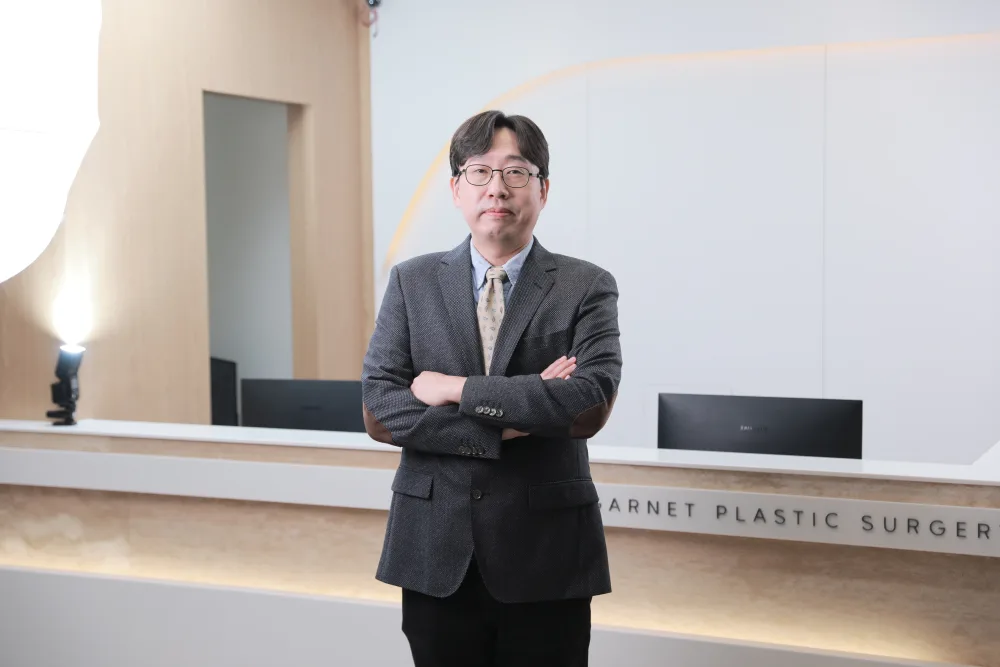
Dr. In-Soo Baek

Dr. In-Soo Baek

Director & sole operating surgeon
Korean medical licence no. 77407
  • Board-certified plastic surgeon
  • Korea University College of Medicine & graduate school (plastic surgery)
  • Member, Korean Society of Plastic and Reconstructive Surgeons (facial-contour, eye & rhinoplasty groups)
  • Every case planned, performed and followed up by the same surgeon
About the surgeon →

What patients say

4.8
★★★★★
92 verified patient reviews
Verified visit★★★★★

Garnet is well known for neck-wrinkle and lifting surgery. The facility is excellent and I’m thoroughly satisfied with the friendly consultation and the surgeon’s skill.

S
Song
Neck / lifting
Verified visit★★★★★

Director Baek In-soo, thank you so much. Thanks to you I keep getting told I look younger — it feels like I’ve gone back to my younger days.

V
Verified patient
Facial lifting
Verified visit★★★★★

I had upper and lower eyelid surgery and I’m really satisfied. The director and the manager were both so kind and clear.

V
Verified patient
Eye surgery
Verified visit★★★★★

I started with under-eye fat repositioning — the director and the manager are genuinely kind and good at what they do. I’ll be back.

V
Verified patient
Under-eye
Verified visit★★★★★

I came on a referral and was very satisfied thanks to the doctor’s kind consultation and clear explanations. The nurses were friendly too.

K
Kim
Consultation
Verified visit★★★★★

I kept reading the reviews and came trusting the many mentions of skill and kindness. The clinic was busy with patients and spotless.

V
Verified patient
First visit

A nose shaped from your own cartilage

Implant-free rhinoplasty is a surgical reshaping of the nose that uses only the patient's own (autologous) cartilage to raise the bridge and build the tip, placing no silicone or other alloplastic implant in the nose. At Garnet the dorsum is commonly augmented with ear (conchal) cartilage and the tip is supported with septal cartilage, so the entire reconstruction is living tissue from the same patient.

Many people want a higher bridge and a more defined tip but would rather not have a permanent implant in the nose — because of thin skin, a wish to avoid long-term implant issues, or simply a preference for their own tissue. Implant-free rhinoplasty answers that by building the whole nose from autologous cartilage.

At Garnet the usual plan uses ear cartilage to add height to the dorsum and septal cartilage to project and define the tip. Ear cartilage has a gentle natural curve that suits the bridge, while the straighter septal cartilage supports the tip; using the patient's own tissue throughout is intended to integrate with the nose and avoid the specific concerns that come with an implant on the bridge.

This is a single-surgeon operation. Dr. Baek assesses skin thickness, the existing framework and how much cartilage is available, plans the case at consultation, performs it himself and reviews healing at set intervals; the clinic caps the day at two surgeries, so each case has unhurried time. Because cartilage must be harvested and shaped, an implant-free case usually takes a little longer than an implant case — the trade-off for an all-tissue nose.

One surgeon, one plan

From cartilage harvest to dorsal augmentation and tip work — all from your own tissue, every step by Dr. Baek.

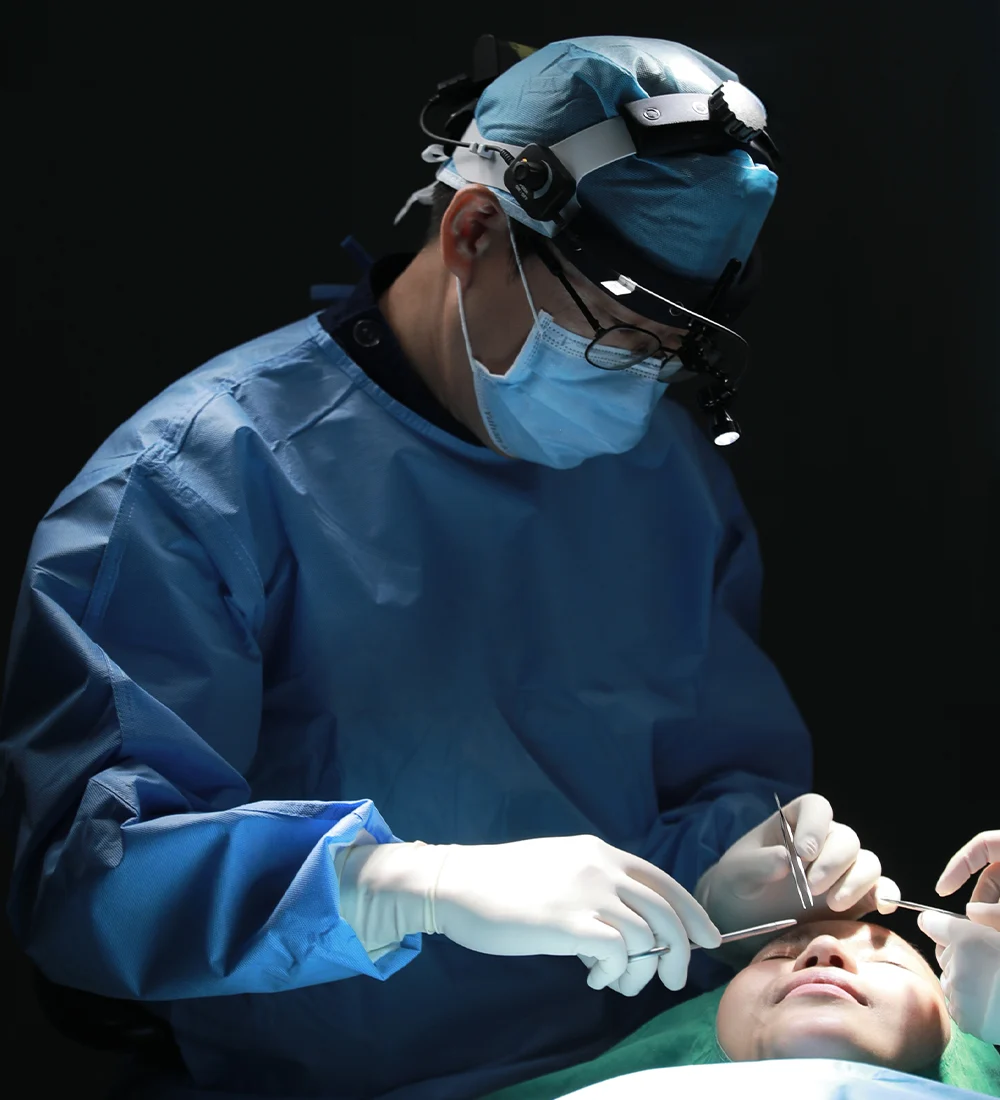
Dr. In-Soo Baek performing surgery at Garnet Plastic Surgery, Apgujeong

A single surgeon, start to finish. Dr. Baek plans the case, performs the operation himself and reviews every follow-up. The clinic caps the day at two surgeries, so each operation has unhurried time.

An implant-free rhinoplasty at Garnet typically takes about 2 hours and is usually carried out under local anaesthesia with sedation, decided with you at consultation; nose dressings are changed on day 1 and day 3, nose sutures come out at about 7 days and the ear donor site at about 10. The steps below outline how the procedure is carried out.

01

Consultation & planning

Dr. Baek assesses the bridge, tip, skin thickness, breathing and how much cartilage is available, and agrees the desired profile. He confirms an implant-free plan suits your goals and chooses the donor sites with you.

02

Approach & incisions

The nose is approached closed (inside the nostrils) or open (a small bridging incision under the tip) depending on the tip work needed, so external scars are hidden inside the nose or in the natural under-tip crease.

03

Cartilage harvest

Ear (conchal) cartilage is taken for the dorsum and septal cartilage for the tip, through hidden incisions; the ear's natural curve suits the bridge while the straighter septum supports the tip.

04

Dorsal augmentation with cartilage

The bridge is raised to the agreed height using the shaped ear cartilage instead of an implant, carved and layered so the dorsum is smooth and matched to the new tip.

05

Tip refinement & fixation

The tip is projected, defined and fixed with the septal cartilage, with adjuncts only where the consultation shows they balance the result; the whole reconstruction is living tissue.

06

Closure, splint & review

Fine closure at the nose and donor sites, a nasal splint and dressings. Because Garnet is single-surgeon, Dr. Baek reviews you himself, changes dressings on day 1 and day 3, removes nose sutures around day 7 and the ear site around day 10.

Why cartilage source matters

The nose is bone in the upper third and cartilage below, draped with skin of varying thickness. To raise a flat bridge and refine an under-defined tip, a graft material is needed — and the body offers several of its own: septal cartilage (straight, central, good for tip support), ear or conchal cartilage (gently curved, well-suited to the dorsum), and rib cartilage for larger framework needs. The septum and ear are the usual donor sites for a primary implant-free case.

Choosing autologous cartilage over an alloplastic implant changes the long-term risk picture. Polymer-based implants used for dorsal augmentation carry a recognised, if generally manageable, rate of complications such as deviation, contour visibility and, uncommonly, infection or extrusion (Maxillofac Plast Reconstr Surg 2022; DOI 10.1186/s40902-022-00344-8); an all-cartilage nose avoids the implant-specific issues at the cost of a donor-site step. Where a patient instead prefers the controllable height an implant gives, a standard rhinoplasty pairs a soft silicone dorsum with an autologous tip.

Implant-free vs implant rhinoplasty

Implant-free (cartilage only)Implant + cartilageRevision rhinoplasty
Dorsum materialOwn ear / septal cartilageSoft silicone graftMaterial chosen per case
Tip materialOwn septal cartilageOwn septal / ear cartilageCartilage / fascia / dermis
Implant in the noseNoneYes, on the dorsumOften removed / replaced
Donor-site stepEar (and septal)None for the dorsumPer chosen material
Best suited toWanting no implant / thin skinWanting clear, controllable heightCorrecting a previous result

A meta-analysis of augmentation with autologous cartilage versus silicone prosthesis found each has its own complication trade-offs, with no single material ideal for every nose (Ann Palliat Med 2022; DOI 10.21037/apm-22-111). An implant-free nose avoids implant-specific issues at the cost of a donor step; Dr. Baek advises which fits your anatomy, and a standard implant + cartilage approach is available.

How your safety is handled

Anaesthesia

An implant-free rhinoplasty is usually performed under local anaesthesia with sedation over a roughly 2 hour operation, decided with you and the anaesthesia team after your medical history is reviewed for comfort and safety.

Single-surgeon care

Because Garnet caps the day at two surgeries, the operation is unhurried and the same surgeon who planned the case carries it out and reviews recovery — there is no separate operating doctor and no rotation of care.

Foreign-patient programme

Garnet is registered with Korea's foreign-patient programme; pre-operative checks, scheduling and after-care are coordinated for international visitors in English.

Honest assessment

If your goals would be better met by an implant approach, more framework or no surgery, that is said at consultation. Whether enough cartilage is available is confirmed before planning, and photos can be reviewed before you travel.

Nasal incisions & the ear donor site

Nasal incisions are mostly hidden inside the nostrils with a closed approach. When tip work needs an open approach, a single fine line sits across the columella in its natural crease. Because the bridge is built from cartilage rather than an implant, there is no implant pocket — but there is a donor site.

The ear (conchal) cartilage is taken through an incision hidden in a natural fold of the ear, leaving the ear's shape unchanged; the donor sutures come out a little later than the nose, at about day 10. Septal cartilage is harvested from inside the nose with no external scar. All scars are designed to settle discreetly; healing varies by individual, and Dr. Baek reviews maturation and advises on scar care at the 1-, 3- and 6-month visits.

Before & After

Implant-free rhinoplasty before/after sets are identifiable and are reviewed privately at consultation with consent, rather than published on this page. Results, recovery and suitability vary by individual and are not guaranteed.

Request before & after examples privately

Week by week

Days 1–3
A nasal splint and dressings are in place and the ear donor site is dressed; the nose feels blocked and the mid-face is swollen. Rest with the head elevated, use cold compresses as advised, and avoid pressure on the treated ear. Dressings are changed on day 1 and day 3; discomfort is usually manageable with prescribed medication.
Days 4–7
Swelling and bruising around the eyes and nose begin to fade. The splint stays on, and nose sutures are removed at about day 7 when it comes off. The ear remains a little tender.
Weeks 1–2
Most social downtime is over for everyday settings once the splint is off, though the nose stays firm and slightly swollen. The ear donor sutures come out around day 10. Light routine and desk work resume as advised.
Weeks 2–6
Bruising clears and the bridge looks settled; the tip remains firmer and is the slowest area to refine. The ear donor site settles. Glasses, strenuous exercise and contact activities wait until cleared at follow-up.
Months 1–6
The tip continues to soften and the final shape emerges over several months as the grafted cartilage integrates. Dr. Baek reviews healing at one, three and six months — in person, or by messenger after you return home.

Do

Keep the head elevated, use cold compresses early, take medication as prescribed, keep the splint and ear dressing dry, sleep on your back, and keep your follow-up visits.

Avoid

Knocking or pressing the nose, sleeping on the treated ear, resting glasses on the bridge, blowing the nose forcefully early on, strenuous exercise and heavy lifting, alcohol and smoking, hot showers/saunas, and direct sun until cleared.

How long does it last?

Implant-free rhinoplasty makes a structural change in living autologous tissue, so the grafted cartilage integrates and the result is long-lasting. Building the whole nose from the patient's own cartilage avoids the implant-specific long-term concerns — deviation, contour visibility and, uncommonly, infection or extrusion — that polymer dorsal implants can carry (Oh et al, Maxillofac Plast Reconstr Surg 2022; DOI 10.1186/s40902-022-00344-8).

Autologous cartilage can, over years, undergo a small amount of resorption or warping, which is part of the consultation discussion; meta-analysis comparing cartilage and silicone shows each material has its own profile rather than one being uniformly superior (Ann Palliat Med 2022; DOI 10.21037/apm-22-111). The nose still ages slowly, and if a previous result ever needs correcting, revision rhinoplasty is assessed individually.

Often planned together

Implant approach

Where controllable dorsal height matters more than avoiding an implant, a standard rhinoplasty pairs a soft silicone bridge with an autologous tip; Dr. Baek explains the trade-off at consultation.

More framework

When the nose needs a stronger structure than ear and septal cartilage provide, rib-cartilage rhinoplasty supplies a larger autologous framework, still implant-free.

Tip cartilage detail

For tip projection and definition specifically, a septal / ear-cartilage plan focuses the autologous cartilage where the tip needs support.

Revision planning

If you have had a previous rhinoplasty elsewhere, revision rhinoplasty is assessed individually with your operative history and photographs.

An honest word on risk

Every operation carries risk. For an implant-free rhinoplasty the considerations include swelling that takes months to settle (especially at the tip), asymmetry, and graft-related issues such as a small chance of cartilage resorption or warping over time. There is also a donor site: a dressed ear that is tender for a while, with a hidden incision. Because no implant is placed, the deviation, contour and extrusion risks specific to alloplastic dorsal implants are avoided (Maxillofac Plast Reconstr Surg 2022; DOI 10.1186/s40902-022-00344-8).

Other possible risks include changes in skin sensation around the nose or the ear donor area, scar-related issues at an open-approach or ear site, breathing changes, and the need for revision in a minority of cases. Smoking raises wound-healing and skin risks. These are explained individually at consultation so expectations are realistic.

What reduces risk in practice: confirming enough usable cartilage before planning, shaping and layering the grafts carefully, meticulous donor-site closure, and follow-up by the operating surgeon. Garnet's single-surgeon, low-volume model is built around exactly this kind of unhurried planning and personal after-care.

Planning from abroad

Most international patients plan roughly 10–14 days in Korea for an implant-free rhinoplasty, so the splint can come off and both the nose sutures (about day 7) and the ear donor sutures (about day 10) be removed by the surgeon before travel. The coordinator confirms the timing for your specific plan.

Before you travel, send clear photos (front, three-quarter and side, plus a relaxed profile) and a note on your concern and dates through WhatsApp, LINE or the form below. You'll get an honest pre-assessment — including whether an implant-free plan suits your skin and cartilage — rather than a hard sell.

Garnet is registered with Korea's foreign-patient programme and coordinates consultations, scheduling and after-care in English. After you return home, Dr. Baek can continue to review your recovery by messenger as the grafted tip settles.

Guides for international patients

Questions about this procedure

What does implant-free rhinoplasty use instead of an implant?
Only your own cartilage. At Garnet the bridge is commonly raised with ear (conchal) cartilage and the tip is built with septal cartilage, so no silicone or other implant is placed in the nose. The ear's curve suits the dorsum, while the straighter septum supports the tip.
How is implant-free rhinoplasty different from implant rhinoplasty?
Both reshape the bridge and tip, but they differ in the dorsum material. An implant-free rhinoplasty raises the bridge with your own ear cartilage and builds the tip from septal cartilage, with no implant in the nose but an ear donor step. A standard implant rhinoplasty raises the bridge with a soft silicone graft and builds the tip from cartilage, giving clear, controllable height without a donor site. The implant-free route avoids implant-specific long-term concerns, while the implant route offers very controllable dorsal height. Meta-analyses show each material has its own trade-offs, so the choice is individual and decided at consultation.
Implant-free (cartilage only)Implant + cartilageRevision rhinoplasty
Dorsum materialOwn ear / septal cartilageSoft silicone graftMaterial chosen per case
Tip materialOwn septal cartilageOwn septal / ear cartilageCartilage / fascia / dermis
Implant in the noseNoneYes, on the dorsumOften removed / replaced
Donor-site stepEar (and septal)None for the dorsumPer chosen material
Best suited toWanting no implant / thin skinWanting clear, controllable heightCorrecting a previous result
Does Dr. Baek perform the surgery himself?
Yes. Garnet is a single-surgeon practice, so Dr. Baek handles the consultation, the operation and the follow-up personally. There is no separate operating doctor and no rotation of care, and the clinic caps the day at two surgeries so each case has unhurried time.
How long does implant-free rhinoplasty last?
It is a structural change in living tissue that integrates over time, so it is long-lasting. Cartilage can undergo a small amount of resorption or warping over years, which is discussed at consultation; the nose also ages slowly. If a previous result ever needs correcting, revision rhinoplasty is assessed individually.
How long should I stay in Korea?
Most international patients plan about 10–14 days, so the splint comes off and both nose sutures (about day 7) and ear donor sutures (about day 10) are removed by the surgeon before travel. The coordinator confirms timing for your plan.
What anaesthesia is used and how much pain is there?
Usually local anaesthesia with sedation over a roughly 2 hour operation, decided with you after your history is reviewed. Most patients describe blockage and pressure at the nose and tenderness at the ear rather than sharp pain, managed with prescribed medication.
Where are the scars and donor site?
Nasal incisions hide inside the nostrils, or a fine line in the under-tip crease with an open approach. The ear donor incision sits in a natural fold and leaves the ear's shape unchanged; septal cartilage is taken from inside the nose with no external scar. All settle discreetly once mature.
When will I look presentable?
Most social downtime is over by about 1–2 weeks once the splint is off, though the nose stays firm and a little swollen and the ear is briefly tender. Bruising clears over the first couple of weeks, and the tip refines over months.
Is implant-free better than an implant rhinoplasty?
Neither is universally better — they suit different goals. Implant-free avoids implant-specific concerns and suits thin skin or a preference for your own tissue, while an implant approach gives very controllable height without a donor site. The right choice depends on your anatomy and priorities, decided at consultation.
What if I don't have enough cartilage?
Whether enough septal and ear cartilage is available is confirmed before planning. If more framework is needed than they provide, rib-cartilage rhinoplasty supplies a larger autologous source while still avoiding an implant — discussed with you at consultation.
What are the main risks?
Swelling that takes months to settle at the tip, asymmetry, a small chance of cartilage resorption or warping, and a tender ear donor site. Because no implant is used, deviation and extrusion risks specific to implants are avoided. Sensation changes and the need for revision in a minority are also discussed individually.
Can I see before-and-after photos?
Noses are identifiable, so implant-free sets are reviewed privately at consultation with consent rather than published here. A standard rhinoplasty example is shown elsewhere on this site.
Will the result look natural?
The aim is a balanced profile in living tissue. Matching the cartilage dorsal height to the tip and using the ear's natural curve on the bridge — as in a septal / ear-cartilage plan — is intended to keep the nose proportionate to your face rather than over-projected.
Can you correct a nose operated on elsewhere without an implant?
Previously operated noses are assessed as a revision rhinoplasty, where an implant-free, all-cartilage plan is often possible; bring your operative history and photos so the right material can be chosen.
How do I start without flying to Korea first?
Send photos and your dates through WhatsApp, LINE or the form below. You'll get an honest pre-assessment — including whether an implant-free plan suits your skin and cartilage — before you plan a trip.

Sources

  1. Oh SH, et al. Prevalence of complications associated with polymer-based alloplastic materials in nasal dorsal augmentation: a systematic review and meta-analysis. Maxillofac Plast Reconstr Surg. 2022. DOI 10.1186/s40902-022-00344-8. link
  2. A systematic review and meta-analysis of the efficacy and complication rates of augmentation rhinoplasty with autologous cartilage and silicone prosthesis. Ann Palliat Med. 2022. DOI 10.21037/apm-22-111. link
  3. Yang HJ, et al. Comparison of Autologous vs Homologous Costal Cartilage Grafts in Dorsal Augmentation Rhinoplasty: A Systematic Review and Meta-analysis. JAMA Otolaryngol Head Neck Surg. 2020. DOI 10.1001/jamaoto.2019.4787. link
  4. Costa LMC, et al. Rhinoplasty Complications and Reoperations: Systematic Review. Int Arch Otorhinolaryngol. 2016. DOI 10.1055/s-0036-1586489. link

Citations are provided for general education. This page is informational and does not replace an in-person consultation; suitability, technique and recovery are individual.

Ask Dr. Baek’s team

Send photos and your question before you travel. An English-speaking coordinator reviews every enquiry and replies with honest guidance on whether surgery is appropriate, the likely plan and timing.

  • Reviewed by the clinic coordinator, not a bot
  • Photo-based pre-assessment before you fly
  • Foreign-patient scheduling & after-care
  • One surgeon for consultation, surgery and follow-up

Prefer to chat now? Reach the coordinator directly:

Request a consultation

  • WhatsApp
  • LINE
  • WeChat
  • Telegram
  • Email
  • Eye surgery
  • Rhinoplasty
  • Facial lifting
  • Forehead & brow
  • Fat grafting & contouring
  • Revision

Submits in real time to Garnet’s Supabase intake (branch: garnet). Your details are handled per our privacy policy.

Book consultation