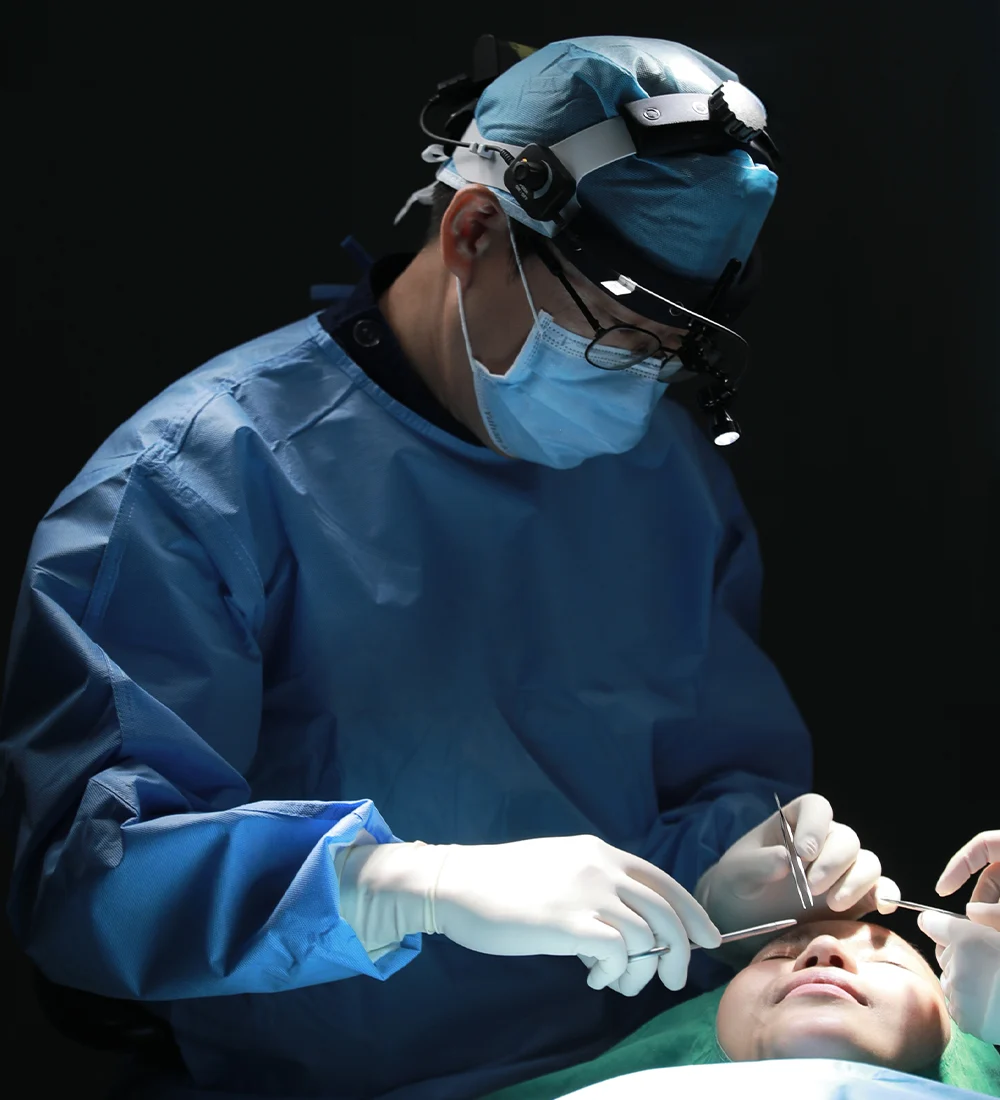
A neck lift tightens the muscle and re-drapes the skin of the neck to sharpen the jawline and the angle beneath the chin. At Garnet it is planned and performed by one board-certified plastic surgeon, Dr. In-Soo Baek, from consultation through every follow-up.

Garnet is well known for neck-wrinkle and lifting surgery. The facility is excellent and I’m thoroughly satisfied with the friendly consultation and the surgeon’s skill.
Director Baek In-soo, thank you so much. Thanks to you I keep getting told I look younger — it feels like I’ve gone back to my younger days.
I had upper and lower eyelid surgery and I’m really satisfied. The director and the manager were both so kind and clear.
I started with under-eye fat repositioning — the director and the manager are genuinely kind and good at what they do. I’ll be back.
I came on a referral and was very satisfied thanks to the doctor’s kind consultation and clear explanations. The nurses were friendly too.
I kept reading the reviews and came trusting the many mentions of skill and kindness. The clinic was busy with patients and spotless.
A neck lift is a surgical neck-rejuvenation operation that tightens the platysma muscle and the SMAS and re-drapes the overlying skin, through incisions beneath the chin and around the ears, to sharpen the jawline and the angle beneath the chin. It addresses neck bands and a loose or full under-chin that are driven by muscle and skin laxity rather than by surface texture alone.
The neck shows age in a few specific ways: vertical bands appear where the platysma muscle edges separate and slacken, the under-chin loses its clean angle, and the jawline softens as the soft tissue descends. These are problems of muscle and skin support, not of skin surface, so creams and surface treatments cannot reach the cause.
A neck lift works on that deeper structure. The edges of the platysma are tightened — and where indicated joined in the midline (corset platysmaplasty) — the SMAS is re-suspended, and the skin is re-draped without tension. The result is a defined jawline and a cleaner angle beneath the chin, addressing the bands and fullness directly. The same principles inform the corset platysmaplasty and the contouring Pelican™ procedure used for the under-chin.
At Garnet this is a single-surgeon operation. Dr. Baek assesses what is driving your neck change — muscle, skin, fat, or a combination — and plans accordingly, then performs and reviews the case himself. The clinic caps the day at two surgeries, so each case has unhurried time, and the aim is to match the technique to the concern rather than over-treat.
From incision design to the platysma tightening and tension-free closure — every step by Dr. Baek.
A single surgeon, start to finish. Dr. Baek plans the case, performs the operation himself and reviews every follow-up. The clinic caps the day at two surgeries, so each operation has unhurried time.
A neck lift typically runs about 2–3 hours and is performed under local anaesthesia with sedation or general anaesthesia as appropriate, decided with you after your history is reviewed. The steps below outline how the platysma and skin work is carried out at Garnet.
Dr. Baek assesses the neck in person — the platysma bands, the under-chin fullness, skin laxity and the jawline — and agrees what to address and the incision design with you. The plan reflects whether muscle, skin, fat or a combination is driving the change.
Lines are placed beneath the chin (submental) and in the natural creases around and behind the ears (post-auricular), so they settle into existing contours and the hairline as they heal.
The slackened edges of the platysma are tightened and, where indicated, joined in the midline as a corset platysmaplasty; the SMAS is re-suspended so the muscle layer supports the neck rather than the skin.
Any sub-platysmal fullness is addressed as indicated, the under-chin angle is refined (the Pelican™ contouring step where appropriate), and the skin is re-draped and trimmed without tension.
Where the consultation shows it, a facelift or a corset platysmaplasty is performed in the same sitting to balance the jawline and neck.
Fine closure, dressing and light compression or a support garment. Because Garnet is single-surgeon, Dr. Baek reviews you himself before you settle in and at each follow-up.
The platysma is a broad, thin sheet of muscle across the front of the neck; with age its paired medial edges separate and slacken, which is what produces the vertical neck bands and a blunted angle beneath the chin. Tightening and re-suspending this platysma-SMAS unit is the core of a lasting neck lift, and is what sharpens the cervicomental angle (Aesthetic Surg J 2025; DOI 10.1093/asj/sjaf023).
Depending on the neck, the change can be muscular (band laxity), skeletal-volume (fullness beneath the platysma), skin (laxity and re-draping), or a mix. The retaining ligaments along the jawline also loosen with age and contribute to the softened border (Mendelson, Aesthetic Plast Surg 2013; DOI 10.1007/s00266-013-0066-8). Garnet plans which of these to address for each neck individually, and frequently pairs neck work with a facelift since the jawline and neck age as one unit.
| Non-surgical | Corset platysmaplasty | Full neck lift | |
|---|---|---|---|
| Type | Energy / injectable | Midline muscle repair | Muscle + skin surgery |
| Addresses | Mild skin / fat | Central platysma bands | Bands, jawline & skin |
| Skin re-draping | No | Limited | Yes |
| Best stage | Very early / mild | Band-dominant necks | Combined muscle & skin laxity |
| Durability | Shorter-lasting | Durable for bands | Most comprehensive |
A systematic review of platysma neck-lift surgery reports a low pooled band-recurrence rate of about 1.4% across 2,106 patients (Facial Plast Surg 2024, DOI 10.1055/s-0044-1791690). The right choice is individual — for the jawline-and-neck picture, the editorial guide deep-plane vs SMAS facelift helps frame it, and Dr. Baek advises at consultation.
A neck lift is usually performed under local anaesthesia with sedation, or general anaesthesia where preferred, decided with you and the anaesthesia team for a roughly 2–3 hour operation. Your medical history is reviewed beforehand.
Because Garnet caps the day at two surgeries, the operation is unhurried and the same surgeon who planned the case carries it out and reviews recovery — there is no separate operating doctor and no rotation of care.
Garnet is registered with Korea's foreign-patient programme; pre-operative checks, scheduling and after-care are coordinated for international visitors in English.
If a lighter option or a combined facelift suits you better, that is said at the consultation. Photos can be reviewed before you travel.
Neck-lift incisions are placed where they can hide: a small line beneath the chin in the natural shadow, and lines in the creases around and behind the ears that run into the hairline. The skin is re-draped without tension, which is one of the factors associated with finer, flatter scars over time.
Scars are permanent but are designed to settle into existing contours, the under-chin shadow and the hairline, so they are not usually obvious in everyday settings once mature. Healing varies by individual and skin type; Dr. Baek reviews scar maturation at the 1-, 3- and 6-month visits and advises on scar care.
Neck-lift before/after sets are reviewed privately at consultation, as faces are identifiable. Results, recovery and suitability vary by individual and are not guaranteed.
Request before & after examples privatelyKeep the head elevated, wear the support garment as advised, use cold compresses early, take medication as prescribed, sleep on your back, walk gently, and keep your follow-up visits.
Strenuous exercise, heavy lifting and straining early on, alcohol and smoking, very hot showers/saunas, and direct sun on healing scars until cleared.
No neck lift stops ageing, but tightening and re-suspending the platysma is a durable way to sharpen the neck because it addresses the muscle that produces the bands rather than the skin alone. In a pooled analysis of platysma neck-lift surgery, band recurrence was low — about 1.4% across 2,106 patients (Cambiaso-Daniel et al., Facial Plast Surg 2024; DOI 10.1055/s-0044-1791690).
Individual longevity depends on tissue quality, weight stability and how the neck and jawline age afterwards. Because the jawline and neck age as one unit, a neck lift planned with a facelift where indicated tends to give a more balanced and lasting result; Garnet plans the neck so it sits naturally from the start.
A neck lift and a facelift are frequently planned together, since the jawline and neck age as one unit and treating them separately can leave a mismatch at the border.
Where central neck bands dominate, a corset platysmaplasty joins the platysma edges in the midline as part of, or alongside, the neck lift.
For an earlier jawline concern, a mini facelift or Deep mini facelift™ may pair with neck work through shorter access.
Fat grafting can restore lost volume along the jawline or lower face that lifting alone does not replace, for a more balanced rather than only tighter look.
Every operation carries risk. For facelift and neck-lift surgery the most reported early complication is haematoma (a collection of blood under the skin), with infection much less common; in a large analysis of 11,300 facelift patients, haematoma occurred in about 1.1% and infection in about 0.3% (Aesthetic Surg J 2016; DOI 10.1093/asj/sjv162). High blood pressure is a recognised risk factor.
Neck-specific risks include temporary changes in skin sensation, asymmetry, scar-related issues, contour irregularity, and — uncommonly — temporary or, rarely, lasting weakness of a nerve branch affecting the lower lip or neck. In pooled neck-lift data overall nerve damage was about 0.9%. Smoking raises wound-healing risks. These are explained individually at consultation.
What reduces risk in practice: careful patient selection and blood-pressure control, meticulous technique, a tension-free skin closure, and follow-up by the operating surgeon. Garnet's single-surgeon, low-volume model is built around exactly this kind of unhurried planning and personal after-care.
Most international patients plan roughly 12–16 days in Korea for a neck lift, since sutures come out at about 10–14 days and are best removed by the surgeon before travel, once the early swelling has settled. The coordinator confirms the timing for your specific plan.
Before you travel, send clear photos (front, three-quarter, side and chin-down) and a note on your concern and dates through WhatsApp, LINE or the form below. You'll get an honest pre-assessment — including whether a neck lift alone or a combined facelift fits — rather than a hard sell.
Garnet is registered with Korea's foreign-patient programme and coordinates consultations, scheduling and after-care in English. After you return home, Dr. Baek can continue to review your recovery by messenger.
| Non-surgical | Corset platysmaplasty | Full neck lift | |
|---|---|---|---|
| Type | Energy / injectable | Midline muscle repair | Muscle + skin surgery |
| Addresses | Mild skin / fat | Central platysma bands | Bands, jawline & skin |
| Skin re-draping | No | Limited | Yes |
| Best stage | Very early / mild | Band-dominant necks | Combined muscle & skin laxity |
| Durability | Shorter-lasting | Durable for bands | Most comprehensive |
Citations are provided for general education. This page is informational and does not replace an in-person consultation; suitability, technique and recovery are individual.
Send photos and your question before you travel. An English-speaking coordinator reviews every enquiry and replies with honest guidance on whether surgery is appropriate, the likely plan and timing.
Prefer to chat now? Reach the coordinator directly: