
Garnet Plastic Surgery · Apgujeong, Seoul — one board-certified surgeon, eye · nose · lifting
Procedures
Eye Surgery
Lower blepharoplasty Upper blepharoplasty Non-incision double eyelid Incision double eyelid Ptosis correction Epicanthoplasty Lateral canthoplasty Under-eye fat repositioning Sub-brow / brow lift Round eye correction
Rhinoplasty
Rhinoplasty Implant-free rhinoplasty Revision rhinoplasty Rib-cartilage rhinoplasty Septal/ear-cartilage rhinoplasty
Facial Lifting
Mini facelift Deep mini facelift™ Full facelift Neck lift
Forehead & Brow
Forehead lift Forehead reduction
Fat Grafting & Contouring
Fat grafting Stem cell fat grafting Pelican™ double-chin & neck contouring Fixpoint Thread Lift™ Neck/cheek/jawline liposuction Corset platysmaplasty
Surgeon Trademarks Before & After Visiting FAQ Book Consultation
Garnet/Rhinoplasty/Revision rhinoplasty
Board-certified Plastic Surgeon · Apgujeong, Seoul

Revision rhinoplasty — rebuilt with the right material, by the surgeon who follows you through it.

Revision rhinoplasty corrects a nose after a previous operation, rebuilding support with the graft material each case needs rather than a single default. At Garnet it is planned and performed by one board-certified plastic surgeon, Dr. In-Soo Baek, from consultation through every follow-up.

Open
approach for control
5
graft sources available
1
surgeon, every step
Anaesthesia
Discussed at consultation
Surgery time
Longer than primary
Sutures out
7–14 days by donor site
Social downtime
~2–3 weeks
Follow-up
1 / 3 / 6 months
10,000+ rhinoplasty cases since 2011· Board-certified plastic surgeon — accredited member, Korean Society of Plastic & Reconstructive Surgeons· Foreign-patient programme registered· Single-surgeon practice

The bottom line

What it is
A corrective nose operation after previous rhinoplasty, usually through an open approach, that releases scar tissue and rebuilds the framework with the graft material the individual nose requires.
Best for
A nose left over-reduced, deviated, contracted, breathing-impaired or unhappy after one or more earlier operations — and a wish to address both shape and function.
Who performs it
Dr. In-Soo Baek only — a board-certified plastic surgeon and Garnet's sole operating doctor. The same surgeon consults, operates and follows up.
Downtime
Sutures come out from about 7 to 14 days depending on the donor site; most social downtime is over by roughly 2–3 weeks; the tip settles over several months.
Material
Chosen per case: septal & ear cartilage, autologous or donor rib, temporalis fascia, or hip dermis — matched to how much support is missing.
How to start
Send photos and your surgical history through WhatsApp or the form below for an honest, no-obligation pre-assessment before you travel.
Candidacy What it is How it's performed The scarred nose Revision vs primary Anaesthesia & safety Incisions & scars Before & after Recovery Longevity Combining Risks International patients FAQ

Is it right for you?

Often a good fit

  • An unsatisfactory shape, deviation, contraction or breathing problem after a previous rhinoplasty
  • Realistic, discussed expectations and an understanding that a revision rebuilds rather than perfects
  • Tissue that has settled sufficiently since the last operation, assessed individually
  • General good health and willingness to plan ~2–3 weeks of social downtime
  • Willingness to accept a donor-site incision where extra graft material is required

Worth discussing other options

  • A nose still healing soon after recent surgery — timing is assessed individually
  • Looking for a same-week, no-downtime correction
  • Uncontrolled medical conditions — assessed individually at consultation
  • Expecting a guaranteed identical match to a reference photo
  • Active smoking, which raises wound-healing and skin risk — discussed and planned around
Dr. In-Soo Baek

Dr. In-Soo Baek

Director & sole operating surgeon
Korean medical licence no. 77407
  • Board-certified plastic surgeon
  • Korea University College of Medicine & graduate school (plastic surgery)
  • Member, Korean Society of Plastic and Reconstructive Surgeons (facial-contour, eye & rhinoplasty groups)
  • Every case planned, performed and followed up by the same surgeon
About the surgeon →

What patients say

4.8
★★★★★
92 verified patient reviews
Verified visit★★★★★

Garnet is well known for neck-wrinkle and lifting surgery. The facility is excellent and I’m thoroughly satisfied with the friendly consultation and the surgeon’s skill.

S
Song
Neck / lifting
Verified visit★★★★★

Director Baek In-soo, thank you so much. Thanks to you I keep getting told I look younger — it feels like I’ve gone back to my younger days.

V
Verified patient
Facial lifting
Verified visit★★★★★

I had upper and lower eyelid surgery and I’m really satisfied. The director and the manager were both so kind and clear.

V
Verified patient
Eye surgery
Verified visit★★★★★

I started with under-eye fat repositioning — the director and the manager are genuinely kind and good at what they do. I’ll be back.

V
Verified patient
Under-eye
Verified visit★★★★★

I came on a referral and was very satisfied thanks to the doctor’s kind consultation and clear explanations. The nurses were friendly too.

K
Kim
Consultation
Verified visit★★★★★

I kept reading the reviews and came trusting the many mentions of skill and kindness. The clinic was busy with patients and spotless.

V
Verified patient
First visit

Rebuilding a nose that has been operated on before

Revision rhinoplasty is a corrective nose operation carried out after one or more previous rhinoplasties, in which scar tissue is released and the nasal framework is rebuilt with grafting material — commonly septal, ear or rib cartilage, with fascia or dermis where soft-tissue coverage is needed. Because the original anatomy and cartilage have already been altered, it is generally more demanding than a first-time operation and is usually approached openly for direct control.

A nose can need revision for several reasons: it may have been over-reduced and left weak, it may have deviated or contracted as it healed, the tip may have lost projection or definition, or breathing may have worsened. The previous surgery has usually used or removed the most convenient cartilage, so the central question of any revision is not only what shape to build but what material is left to build it from.

Garnet's approach is to diagnose the specific problem first, then match the graft to it. Where the septum still has usable cartilage and only modest support is missing, septal and ear (conchal) cartilage can be enough; where the framework has to be substantially rebuilt, rib cartilage provides the volume and strength a depleted nose no longer has. Soft-tissue irregularity is smoothed with temporalis fascia, and contracted skin is sometimes relined with dermis.

At Garnet this is a single-surgeon operation. Dr. Baek reviews the history and any records, plans the case, performs it himself and follows the healing at set intervals; the clinic caps the day at two surgeries so a long revision has unhurried time. The stated aim is to correct the concern you arrived with and to protect the airway, rather than to chase the maximum possible change.

One surgeon, one plan

From history review to scar release, framework rebuild and donor-site closure — every step by Dr. Baek.

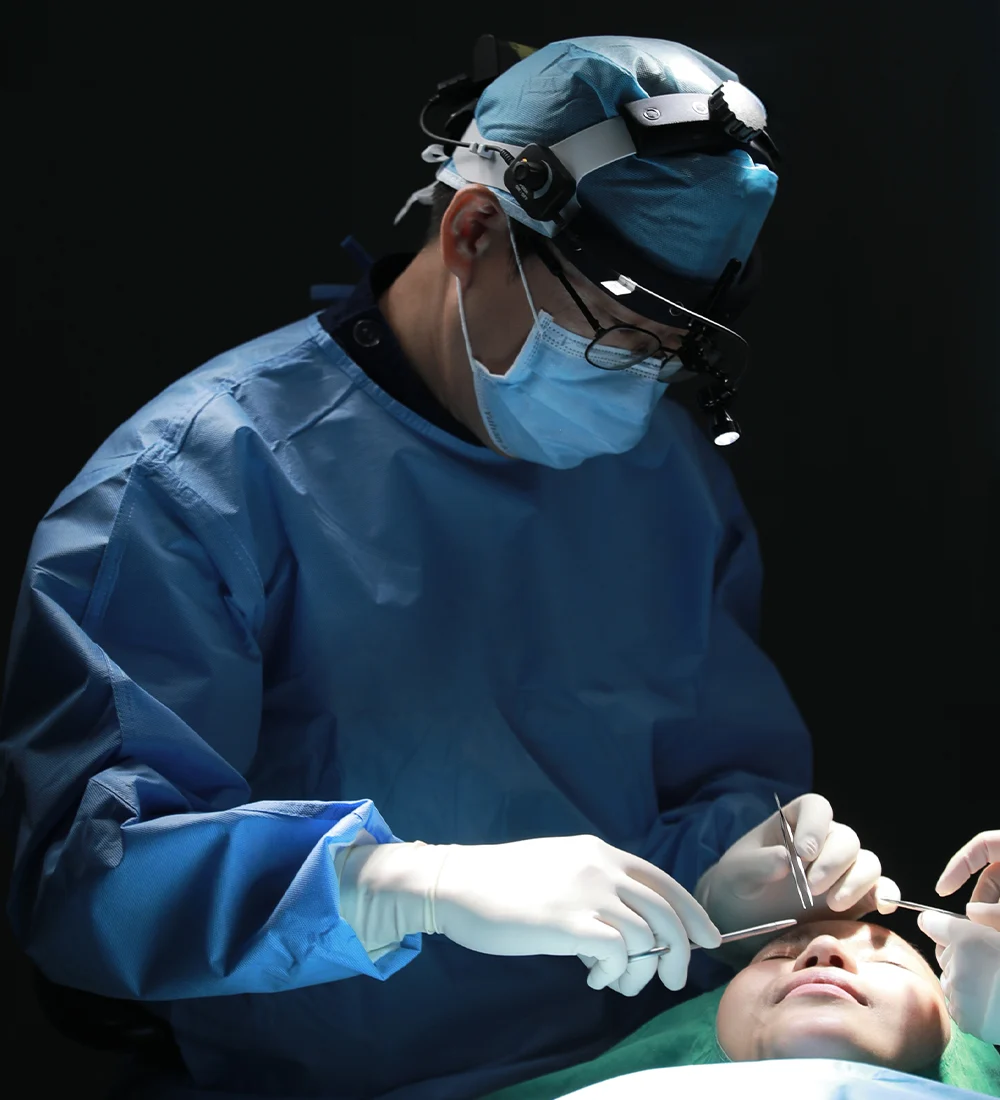
Dr. In-Soo Baek performing surgery at Garnet Plastic Surgery, Apgujeong

A single surgeon, start to finish. Dr. Baek plans the case, performs the operation himself and reviews every follow-up. The clinic caps the day at two surgeries, so each operation has unhurried time.

A revision is generally longer than a primary rhinoplasty because scar must be released before anything is rebuilt; the operating time depends on how much reconstruction and which donor site the plan needs. Anaesthesia is decided with you and the anaesthesia team at consultation after your history is reviewed, rather than fixed in advance. The steps below outline how a revision is carried out at Garnet.

01

History & planning

Dr. Baek reviews your previous operations, any operative records and current breathing, examines the nose and skin in person, and agrees what is realistic and which graft material the case needs. Imaging is used where it adds something.

02

Open approach & scar release

Most revisions use an open approach through a small columellar incision for direct view. Scar tissue is carefully released so the true remaining framework can be assessed before rebuilding.

03

Graft harvest

The chosen material is taken — septal & ear cartilage for moderate needs, rib cartilage for major rebuilding, temporalis fascia for smoothing, or hip dermis for relining a tight envelope.

04

Framework rebuild

Support is reconstructed where it was lost — dorsum, septal extension, tip projection and rotation — using the harvested grafts, so the result rests on a rebuilt structure rather than on tension.

05

Coverage & closure

Fascia smooths any contour seen through thin skin; incisions on the nose and at the donor site are closed; a splint and dressing are applied. A breathing-first mindset guides the rebuild.

06

Dressing & review

Garnet's protocol includes dressing changes on day 1 and day 3. Because the clinic is single-surgeon, Dr. Baek reviews you himself before you settle in and at each follow-up.

Why a second operation is harder

After a first rhinoplasty the nose is no longer a clean anatomical field. Scar tissue replaces the natural glide planes, the skin envelope can be thinned or contracted, and the supporting cartilages — septal, alar and any earlier grafts — may be weakened, displaced or already harvested. These changes are why a revision is generally a longer, more technically demanding operation than a primary one, and why the surgeon must plan around what tissue actually remains (Maxillofac Plast Reconstr Surg 2024; DOI 10.1186/s40902-024-00422-z).

Because septal cartilage is often depleted by the first operation, revision typically draws on other autologous sources. Ear (conchal) cartilage suits tip and alar work; rib (costal) cartilage rebuilds dorsum and structural support; temporalis fascia camouflages thin-skin irregularity; and dermis from the hip can reline a tight envelope. Each donor site adds its own small incision and its own suture-removal timing, which is why a revision plan is described by both the nose and the donor site it borrows from.

Primary vs revision rhinoplasty

Primary rhinoplastyRevision — septum usableRevision — cartilage depleted
Starting pointUntouched anatomyScarred but workable frameworkHeavily scarred, multiple prior operations
Cartilage availableSeptum usually intactSeptal / ear cartilage still usableDepleted — rib or dermis needed
ApproachClosed or open per caseOpen for direct controlOpen with structural rib grafting
ComplexityStandardHigher than primaryHighest — framework is rebuilt
Typical goalReshapeCorrect a specific prior issueRebuild support & protect the airway

A systematic review of autologous costal cartilage rhinoplasty reports recipient-site warping at about 5% and infection at about 2.5% (Aesthet Surg J 2015, DOI 10.1093/asj/sju117), which is part of why material is matched to the case. Which source suits your nose is individual — Dr. Baek advises at consultation.

How your safety is handled

Anaesthesia

The anaesthesia for a revision is chosen with you and the anaesthesia team at consultation, suited to the length of the rebuild and your medical history, rather than set in advance. Your history is reviewed beforehand.

Single-surgeon monitoring

Because Garnet caps the day at two surgeries, a long revision is unhurried and the same surgeon who planned the case carries it out and reviews recovery — there is no separate operating doctor and no rotation of care.

Foreign-patient programme

Garnet is registered with Korea's foreign-patient programme; pre-operative checks, scheduling and after-care are coordinated for international visitors in English.

Honest assessment

If a revision is not yet appropriate — for instance if the tissue needs longer to settle after the last operation — that is said at the consultation. Photos and records can be reviewed before you travel.

Where the incisions sit

A revision is usually open, so there is a small incision across the columella (the strip of skin between the nostrils) together with hidden incisions inside the nostrils. The columellar scar is designed to fall in a natural shadow and is not generally obvious once mature. Any donor site adds its own small, concealed scar — behind the ear for conchal cartilage, in the chest crease for rib, or at the hip for dermis.

Scars are permanent but are placed where they hide and are reviewed by Dr. Baek at the 1-, 3- and 6-month visits, with scar-care advice. Healing varies by individual and by skin type, and revision skin that has already been operated on can behave differently from first-time skin, which is discussed honestly at consultation.

Before & After

Revision rhinoplasty results are highly individual and depend on the previous surgery, so before/after sets are reviewed privately at consultation with consent rather than published here. Results, recovery and suitability vary by individual and are not guaranteed.

Request before & after examples privately

Week by week

Days 1–3
A splint and dressing protect the rebuild. Garnet changes the dressing on day 1 and again on day 3. Swelling and bruising build over the first few days; rest with the head elevated. Discomfort is usually manageable with prescribed medication.
Days 4–7
Swelling around the eyes begins to ease and bruising starts to fade. Gentle walking is encouraged. Nose sutures are typically removed around day 7.
Days 7–14
The splint comes off in this window. Donor-site sutures are removed by site — ear and rib around day 10, temporalis fascia around day 10, hip dermis around day 14. The shape looks fuller than its final form at this stage.
Weeks 2–4
Most social downtime is over for everyday settings, with residual swelling that keeps easing. Light routine resumes as advised; strenuous activity and contact with the nose wait longer.
Months 1–6
Tip swelling settles slowly and the scars mature over the following months. Dr. Baek reviews healing at one, three and six months — in person, or by messenger after you return home.

Do

Keep the head elevated, attend the day-1 and day-3 dressing changes, take medication as prescribed, sleep on your back, protect the splint, and keep your follow-up visits.

Avoid

Bumping or pressing the nose, glasses resting on the bridge early on, strenuous exercise and bending, alcohol and smoking, very hot showers/saunas, and direct sun on healing scars until cleared.

How long does it last?

Once a revised nose has fully healed, an autologous-cartilage framework is intended to give durable, lasting support because it rebuilds structure rather than relying on the skin or on an implant. With cartilage grafts the main longer-term considerations are subtle warping or resorption, which the choice and handling of material are planned to limit (Aesthet Surg J 2015; DOI 10.1093/asj/sju117).

Individual longevity depends on tissue quality, the extent of the previous surgery, and how the nose is protected during healing. Garnet's approach is to rebuild conservatively and protect the airway, since a result that was never over-tightened or over-reduced tends to age more predictably. Further small refinements are occasionally discussed if healing leaves a minor irregularity.

Often planned together

Septal & ear cartilage

For moderate revisions, septal and ear (conchal) cartilage can supply tip support and definition without a chest incision.

Rib cartilage

Where major rebuilding is needed, rib (costal) cartilage provides the volume and strength a depleted nose no longer has.

Functional work

Septal correction or work on the internal valve is addressed in the same sitting where breathing has been affected, so shape and airway are treated together.

Soft-tissue camouflage

Temporalis fascia is used to smooth contour seen through thin skin, and dermis can reline a tight, contracted envelope where indicated.

An honest word on risk

Every operation carries risk, and a revision adds the difficulties of operating in scarred tissue. With autologous cartilage the recognised graft-related issues include warping, partial resorption, displacement and — less commonly — infection; a systematic review of costal cartilage rhinoplasty reported warping in about 5% and infection in about 2.5% of cases (Aesthet Surg J 2015; DOI 10.1093/asj/sju117). Material choice and handling are planned to reduce these.

Other possible risks include asymmetry, contour irregularity, persistent or new breathing difficulty, prolonged tip swelling, scar-related issues, and donor-site discomfort (behind the ear, at the chest, or at the hip). Thin or previously contracted revision skin can heal less predictably. Smoking raises wound-healing risk. These are explained individually at consultation.

What reduces risk in practice: careful diagnosis of what actually remains, matching the graft to the defect, meticulous open-approach technique, a breathing-first mindset, and follow-up by the operating surgeon. Garnet's single-surgeon, low-volume model is built around exactly this kind of unhurried planning and personal after-care.

Planning from abroad

Most international patients plan roughly 10–14 days in Korea for a revision rhinoplasty, so the splint and the nose and donor-site sutures can be removed by the surgeon before travel — the longest timing belongs to a hip-dermis donor site at about 14 days. The coordinator confirms the schedule for your specific plan.

Before you travel, send clear photos (front, three-quarter, side and base), a note on your previous surgery and any operative records, and your dates through WhatsApp, LINE or the form below. You'll get an honest pre-assessment — including whether the tissue is ready for revision — rather than a hard sell.

Garnet is registered with Korea's foreign-patient programme and coordinates consultations, scheduling and after-care in English. After you return home, Dr. Baek can continue to review your recovery by messenger.

Guides for international patients

Questions about this procedure

Can you correct a rhinoplasty done at another clinic?
Yes. Dr. Baek assesses revision cases individually, reviewing the previous surgery and any operative records before planning. Bring photos and records to the consultation, or send them ahead through the form below for an honest pre-assessment of whether a revision is appropriate yet.
How is revision rhinoplasty different from primary rhinoplasty?
A primary operation works on untouched anatomy, while a revision works in scarred tissue where the septal cartilage is often already used. That is why a revision is usually open, generally longer, and frequently needs rib or ear cartilage to rebuild support.
Does Dr. Baek perform the surgery himself?
Yes. Garnet is a single-surgeon practice, so Dr. Baek handles the consultation, the operation and the follow-up personally — there is no separate operating doctor and no rotation of care, which matters for a complex revision.
How long should I wait after my first nose surgery?
Tissue usually needs time to settle before a revision, and the right interval is judged individually from your healing and the previous operation. If it is too soon, that is said honestly so you do not travel before the nose is ready.
What graft material will be used?
It depends on what your nose needs. Modest support can come from septal and ear cartilage; major rebuilding usually needs rib cartilage; fascia smooths thin-skin contour and dermis can reline a tight envelope. The plan is agreed at consultation.
What anaesthesia is used and how much pain is there?
Anaesthesia is decided with you and the anaesthesia team after your history is reviewed, suited to the length of the rebuild. Most patients describe pressure and congestion rather than sharp pain in the first days, managed with prescribed medication.
Where are the scars?
A revision is usually open, leaving a small columellar scar designed to fall in a natural shadow, plus hidden incisions inside the nostrils. Any donor site adds a concealed scar behind the ear, at the chest crease or at the hip.
How long should I stay in Korea?
Most international patients plan about 10–14 days, so the splint and sutures can be removed by the surgeon before travel — a hip-dermis donor site needs about 14 days, the longest. The coordinator confirms timing for your plan before you travel.
When will I look presentable?
Most social downtime is over by about 2–3 weeks for everyday settings, once the splint is off and the major swelling and bruising have eased. The refined tip develops slowly over the following months.
Will my breathing improve?
A revision can address breathing where the previous surgery affected the septum or the nasal valve, and functional work is planned in the same sitting where indicated. Shape and airway are treated together rather than separately.
What are the main risks?
Operating in scarred tissue is more demanding, and cartilage grafts carry small risks of warping, resorption or infection — a costal cartilage review reported warping near 5%. Asymmetry, prolonged tip swelling and donor-site discomfort are also discussed individually at consultation.
Can I see revision before-and-after photos?
Revision results are highly individual and identifiable, so full sets are reviewed privately at consultation with consent rather than published. You can discuss what is realistic for your nose with Dr. Baek directly.
Is rib cartilage always needed for a revision?
No. Rib is used when major rebuilding is required, but many revisions are managed with septal and ear cartilage and fascia. The choice follows how much support is missing, which is assessed at consultation.
Primary rhinoplastyRevision — septum usableRevision — cartilage depleted
Starting pointUntouched anatomyScarred but workable frameworkHeavily scarred, multiple prior operations
Cartilage availableSeptum usually intactSeptal / ear cartilage still usableDepleted — rib or dermis needed
ApproachClosed or open per caseOpen for direct controlOpen with structural rib grafting
ComplexityStandardHigher than primaryHighest — framework is rebuilt
Typical goalReshapeCorrect a specific prior issueRebuild support & protect the airway
How do I start without flying to Korea first?
Send photos, your surgical history and your dates through WhatsApp, LINE or the form below. You'll get an honest pre-assessment — including whether the tissue is ready — before you plan a trip to Garnet in Apgujeong.
Is a revision more expensive than a primary nose job?
A revision is generally more involved than a primary rhinoplasty because it rebuilds support and may need a donor graft, so the quote reflects the work required. Pricing is confirmed at consultation rather than estimated online.

Sources

  1. Varadharajan K, Sethukumar P, Anwar M, Patel K. Complications Associated With the Use of Autologous Costal Cartilage in Rhinoplasty: A Systematic Review. Aesthet Surg J. 2015. DOI 10.1093/asj/sju117. link
  2. Kim JH, et al. Enhanced revision rhinoplasty with processed costal cartilage guided by preoperative computed tomography and 3D scanning. Maxillofac Plast Reconstr Surg. 2024. DOI 10.1186/s40902-024-00422-z. link
  3. Wee JH, et al. Indications, Techniques, and Postoperative Outcomes of Temporalis Fascia Grafting in Rhinoplasty. J Craniofac Surg. 2022. DOI 10.1097/SCS.0000000000008566. link
  4. Wee JH, et al. Donor site morbidities resulting from conchal cartilage harvesting in rhinoplasty. Arch Facial Plast Surg. 2007. DOI 10.1001/archfaci.9.4.298. link

Citations are provided for general education. This page is informational and does not replace an in-person consultation; suitability, technique and recovery are individual.

Ask Dr. Baek’s team

Send photos and your question before you travel. An English-speaking coordinator reviews every enquiry and replies with honest guidance on whether surgery is appropriate, the likely plan and timing.

  • Reviewed by the clinic coordinator, not a bot
  • Photo-based pre-assessment before you fly
  • Foreign-patient scheduling & after-care
  • One surgeon for consultation, surgery and follow-up

Prefer to chat now? Reach the coordinator directly:

Request a consultation

  • WhatsApp
  • LINE
  • WeChat
  • Telegram
  • Email
  • Eye surgery
  • Rhinoplasty
  • Facial lifting
  • Forehead & brow
  • Fat grafting & contouring
  • Revision

Submits in real time to Garnet’s Supabase intake (branch: garnet). Your details are handled per our privacy policy.

Book consultation